
Respect for Human Rights
Basic Policy
Nippon Steel respects human rights and strives to create the working environment which allows diverse human resources to be more empowered.
Basic policy
In compliance with the Universal Declaration of Human Rights and other international norms on human rights, the Nippon Steel Group respects our employees’ diverse views and fully utilizes their individuality via effective communication and collaboration so as to create and deliver enhanced value. Based on the United Nations Guiding Principles on Business and Human Rights, the Nippon Steel Group Conduct Code has been set. By adhering to its principles, Nippon Steel conducts business ethically, while paying full heed to human rights issues arising with the increasing globalization of the economy. Nippon Steel gives due attention to the rights of workers, and staunchly opposes the use of forced or child labor. These are prerequisites of our corporate activities. We have also prohibited as unjust the discriminatory treatment of workers based on nationality, race, belief, creed, gender, age, sexual orientation, and disability. In addition, we give careful consideration to the traditions and culture, business practice, and labor practice of each country or region as we accelerate overseas business development.
The Nippon Steel Group has established the Nippon Steel Group Human Rights Policy to demonstrate this corporate stance within and outside the Group. This policy has been approved by the Board of Directors of Nippon Steel Corporation.
Nippon Steel Group Human Rights Policy
- 1Commitment to respecting human rights
The Nippon Steel Group supports and respects internationally-recognized human rights (freedom of association, right to organize, right to collective bargaining, the elimination of forced or compulsory labor, the abolition of child labor, the elimination of discrimination in respect of employment and occupation, and a safe and healthy working environment, etc.) expressed in the “International Bill of Human Rights” and “ILO Declaration on Fundamental Principles and Rights at Work” by the International Labour Organization (ILO) and “Guiding Principles on Business and Human Rights” by the United Nations.
Based on the recognition that respect for all human rights is the prerequisite of corporate activities, the Nippon Steel Group promotes its business activities with high ethical standards while taking utmost care for respecting human rights based on the “Nippon Steel Corporation Group Code of Conduct”, which was established in consideration of corporate social responsibilities. - 2Scope
This policy shall be applicable to all officers and employees of the Nippon Steel Group. The Nippon Steel Group also seeks ways that all stakeholders, including suppliers, understand and support this policy.
- 3Compliance with applicable laws and regulations
The Nippon Steel Group complies with laws and regulations of the countries and regions in which the Group promotes business activities. In regions where internationally recognized human rights are not appropriately protected by laws and regulations, the Group strives to respect internationally recognized human rights to the fullest extent possible.
- 4Human rights due diligence
The Nippon Steel Group establishes a system for human rights due diligence to identify, prevent and mitigate adverse human rights impacts and seeks to promote continuous practice and improvement of the system.
- 5Remedial actions
In the event that it is revealed that the Nippon Steel Group has caused or contributed to an adverse human rights impact in its business activities, the Group strives to take appropriate measures towards remediation thereof.
- 6Education
The Nippon Steel Group strives to provide appropriate ongoing education to its officers and employees on respect for human rights.
- 7Dialogues and discussions with stakeholders
The Nippon Steel Group strives to promote dialogues and discussions with internal and external stakeholders regarding the Group’s initiatives for respect for human rights in its business activities.
- 8Information disclosure
The Nippon Steel Group appropriately discloses information regarding its initiatives concerning respect for human rights and their progress through the website and other means.
- 9Promotion system
The Nippon Steel Group periodically discusses at and reports to the Corporate Policy Committee and the Board of Directors of Nippon Steel Corporation regarding the compliance with this policy.
Nippon Steel Corporation
April 1, 2024
Target and KPI
- Identification of Negative Human Rights Impacts and the Establishment and Implementation of a Human Rights Due Diligence System for Prevention and Mitigation
- Appropriate response for corrective actions or remedy, if it becomes clear that our business activities have caused or contributed to a negative impact on human rights
Initiatives and Achievements
Efforts to prevent human rights abuses
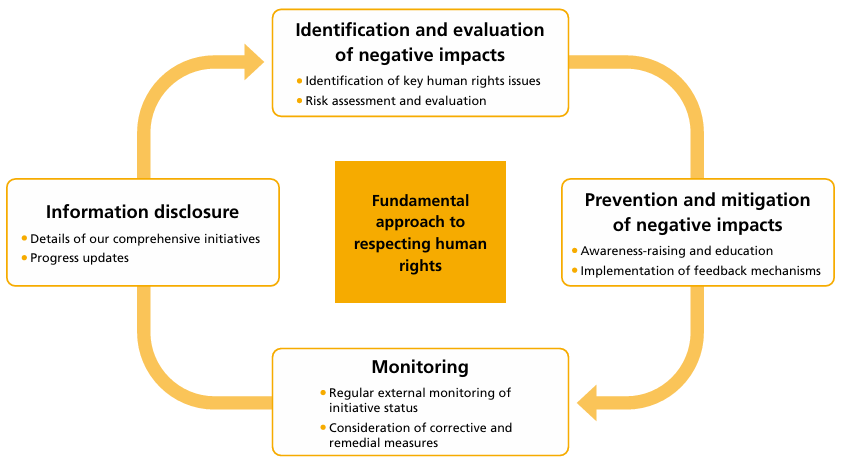
⟨Response inside and outside the Nippon Steel Group⟩
Conduct human rights due diligence
Based on the Human Rights Policy established on April 1, 2024, we have established a human rights due diligence system to identify negative impacts on human rights*1 and to prevent or mitigate such impacts, and we are committed to its continuous implementation and improvement. Specifically, in the mining sector, we conducted questionnaire-based supplier surveys*2, covering five companies in FY2024 and twenty-five companies in FY2025*3. Based on an analysis and review of the responses and publicly available information disclosed by each company, we engage in dialogue with suppliers regarding our assessment of their responses and their future initiatives.
- *1Risks related to forced labor, child labor, occupational health and safety, and other human rights issues.
- *2Suppliers were selected based on factors such as the proportion of total purchase value, product category, and country of origin.
- *3The questionnaire was prepared with reference to the UN Global Compact questionnaire.
Addressing human rights risks
We appoint human rights awareness promoters at each works and office and promote human rights awareness activities at each site. In addition, to advance human rights awareness initiatives across the Company, we hold a “Company-wide Human Rights Awareness Promoters Meeting” at the end of each fiscal year, where participants exchange views on human rights awareness education, emerging human rights risks, and other related issues, and discuss the policy for human rights awareness activities for the following fiscal year. Based on these discussions, at the beginning of the fiscal year, we hold a “Company-wide Human Rights and Anti-discrimination Awareness Promotion Meeting,” chaired by the Executive Officer responsible for Human Resources and Labor Relations and attended by the heads of human resources at each works and office, to determine the policy for human rights awareness activities for the fiscal year.
In addition to implementing human rights awareness activities in accordance with the policies decided at the forum, each steelworks and each office are actively engaged in employee awareness–raising activities, including holding workshops on a specific issue of the steelworks or office. We also participate in enlightenment of organizations and activities hosted by public entities and others in each community. We make concerted efforts for human rights enlightenment within the communities.
Along with the group–wide expansion of our efforts to Group companies in Japan and overseas, we routinely carry out monitoring surveys on the status of compliance with labor–related laws and regulations, the establishment of consultation contacts, and other issues via an internal control checklist.
Through these efforts, we are continuously and systematically promoting activities to prevent human rights abuses. These include the understanding of human rights risks that change with the times and the development of a system and a strategy to reduce the risks.
Prevention of forced or child labor
Adhering to international norms concerning forced or child labor, Nippon Steel has a policy of prevention and eradication of both types of labor. We comply with applicable regulations and conduct regular monitoring surveys of our Group companies to prevent such violations in our business activities.
Compliance concerning salaries
We comply with the laws and regulations of each country and region governing wages, including minimum wages, overtime pay, and equal pay for equal work. In addition, we are committed to providing workers with wages that enable them to maintain an adequate standard of living (living wages).With regard to bonuses, we regularly review practices in different countries, regions, and industries. We also engage in sincere dialogue with labor unions and appropriately return value to employees, taking into account the Company’s business performance and operating conditions.
Human rights awareness education
Based on the policy decided at the “corporate-wide forum of human rights anti–discrimination promotion,” information on human rights awareness is incorporated in training courses for all ranks, from new employees to experienced ones. We also provide education on a variety of subjects, including the issues of harassment and discrimination, understanding of LGBTQ, and human rights issues in the conduct of our business.
Two-way communication with employees based on good labor–management relations is important in order to prevent human–rights abuses. We therefore incorporate education toward building sound labor–management relationships in the training of executives of the Company and the Group companies.
In addition to general education that contributes to the prevention of human rights abuses in workplaces, we also address specific human rights abuse risks in formulating and the oversight of specific work assignments. Examples include education on fair recruitment selection by employees assigned to the tasks of hiring in order to prevent job discrimination, and education on cross-cultural understanding and communication for those assigned to overseas business in the context of preventing human rights abuses (i.e., consideration for each country’s unique traditions, culture, business practices, and labor–management practices).
| The number of recipients of training courses by rank on human rights | 5,316 |
|---|
Mechanism of corrective actions
We have clarified whom to contact for consultation on various compliance issues including human rights. This is a part of the effort to establish a groupwide claims handling mechanism that makes it easy for employees and related personnel to ask for consultation, and that enables the Company to understand and identify incidents of human rights abuses.
Specifically, a Compliance Consultation Room has been established to accept inquiries and reports and give counseling regarding human rights abuses such as harassment, from employees of the Company and Group companies and their families, as well as from employees of business partners. Reports and consultations from various stakeholders are accepted through the Inquiry Form accessible on the website. Regarding the response to these individual incidents, such as internal reports and consultations, we investigate the facts and, if necessary, seek advice from outside parties, including lawyers and outside professional organizations, to protect the privacy of the persons and to ensure that they do not receive unfavorable treatment. We then provide guidance and education to those involved, and strive to appropriately resolve the incidents.
- Inquiry form concerning human rights
-
- Consultation in Japanese:bhr_contact@jp.nipponsteel.com
- Consultations from overseas or in English:https://jacer-bhr.org/en/application/form.html
In the event that a target for correction or remedy is identified, we strive to take appropriate measures, and periodically check and verify the effectiveness of the measures through checklists and other means. We also strive to promote dialogue and discussions with internal and external stakeholders regarding our Group’s initiatives for human rights in its business activities.
Furthermore, since labor-management relations play an important role in preventing human rights abuses and resolving related incidents, in the event of disputes concerning the interpretation of collective agreements, labor-management agreements or other rules directly related to them, a grievance committee is established to resolve the dispute, based on the agreement concerning complaint-handling procedures that has been concluded with the labor union. The committee comprises members from both the management and the labor side.
Communicating with stakeholders
Adhering to laws and the group-company labor agreements, and respecting the rights to organize and to bargain, Nippon Steel strives to maintain sound labor-management relationships. With a focus on mutual understanding through two-way dialogue, we have a place for discussion with labor unions for the entire Company as well as for each steelworks and each office. We discuss the operating and financial performance, safety, health, and production management issues, working conditions such as salaries and bonus payments, balancing of work and personal life, and other issues. Close labor-management communication is also maintained, particularly concerning the actual work cases for which the labor unions received reports from their members. The minutes of these discussions are recorded and shared through the Intranet and other means broadly, from senior management to work union members.
In-house magazines for the entire Company as well as each steelworks and each office are regularly published as a means to send various messages to employees. PR magazines are also published to convey our business and other information outside. Our steelworks and offices also regularly set up a place for dialogue with the nearby residents’ associations to ask for their understanding of our business operations and listen to opinions and requests from them; this is part of what we do to realize better communication with the local community.
| Labor-management discussions | |
|---|---|
| Entire Company | 93 times |
| Steelworks and Offices | 908 times |
| Number of union members and unionized rate |
|---|
| 24,745 (100% unionized) |