
Breakthrough Technology Development to Decarbonize Steelmaking Processes
Technical Issues for realizing a carbon-neutral production process
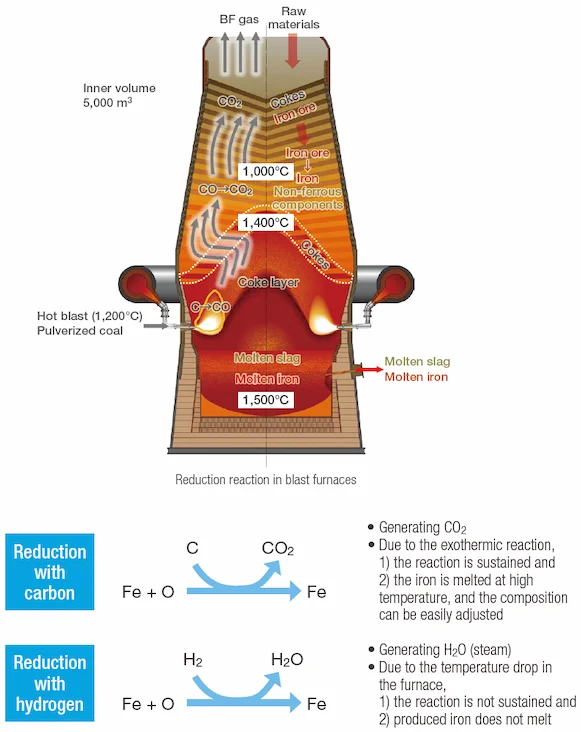
In nature, iron exists as oxidized iron ore. To produce steel products, oxygen must be removed (= reduced) from iron ore. This reduction process has been carried out by the blast furnace (BF) and the basic oxygen furnace (BOF), using carbon such as coal.
In this process, coal (coke) is 1) a reducing agent, 2) a source of heat, and 3) plays a role to support the function of raw materials at high temperature in a solid form while facilitating to maintain ventilation in the furnace. Although the coal (coke) has been utilized in a continuous, efficient steelmaking from iron ore, CO2 is inevitably generated during the reduction reaction.
We are therefore drastically reviewing this process and plans to reduce CO2 emissions by replacing coal (coke) as a reducing agent with hydrogen to produce H2O instead of carbon in the reduction.
However, as reduction with hydrogen is an endothermic reaction, the temperature drop in the furnace causes problems such as the reaction not being sustained and the iron not melting. In order to realize hydrogen steelmaking, we are tackling these problems by development of breakthrough technologies such as 1) high-temperature heating of flammable hydrogen, 2) securing of gas flow in the furnace, 3) additional melting process, and 4) large-scale production for production.
Toward the Development and Implementation of innovative technologies
(1)Initiatives to High-Grade Steel Production in Large size EAFs
Toward the commercial-scale implementation of "high-grade steel production in large size EAFs," Nippon Steel has already started the commercial production of high-grade steel in the integrated EAF steelmaking process in the Hirohata Area, which has been considered difficult to accomplish. In the future, we will continue to develop EAF technologies that offer productivity and quality comparable to the BF–BOF process.
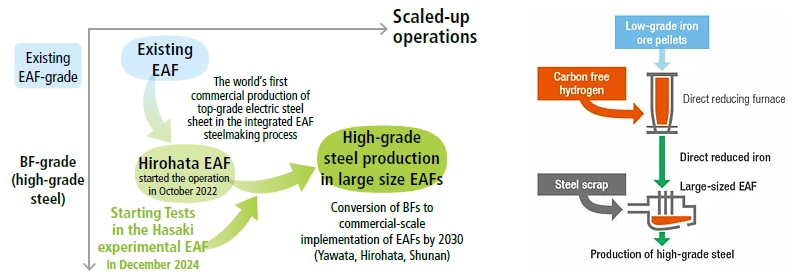
Starting operational tests toward further technology deepening and expansion
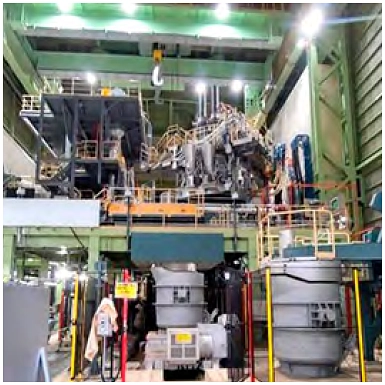
Nippon Steel has completed the installation of an experimental EAF (with a capacity of 10 tons/charge), aimed at developing and verifying the technologies required for the commercial-scale implementation of high-grade steel production technologies at large size EAFs, and has already started tests for high-efficiency dephosphorization and denitrification processes at this experimental EAF from 2025.
(2)Development of technology for hydrogen direct reduction of iron
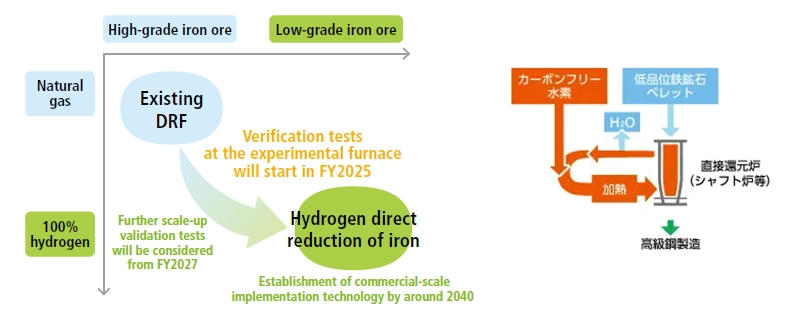
Hydrogen direct reduction of iron requires the conversion of the existing reducing agent to hydrogen. This process also necessitates the development of various innovative technologies that enable the use of lower-grade iron ore.
(3)Initiatives for Commercial-scale Implementation of Hydrogen Injection into BFs
The BF-BOF process is currently the only steelmaking process capable of mass-producing high-grade steel products from iron ore. However, it generates approximately 2 tons of CO2 per ton of steel produced. We are developing the technology of hydrogen injection into BFs, in which carbon (coal), the reducing agent used for the BF process, can be replaced with hydrogen.
Click here for details on the “Green Innovation Fund Project/Hydrogen Utilization Project in Steel Making Process”
Demonstration tests at an experimental BF in anticipation of the implementation of the hydrogen injection into BFs at the actual BF
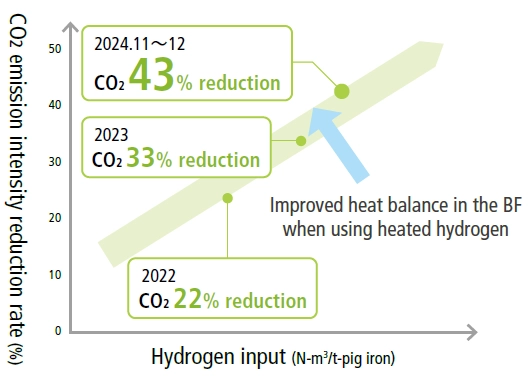
At an experimental BF installed in the East Nippon Works Kimitsu Area, in anticipation of the implementation at a large-scale BF, we are working on technological development through a spiral-up approach combining mathematical model calculations and the verification at the experimental BF to achieve a 50% reduction in CO2 emissions. During our operational tests in December 2024, we achieved a new world record of a 43% reduction in CO2 emissions.
Initiatives for Commercial-scale Implementation of Hydrogen Injection into BFs
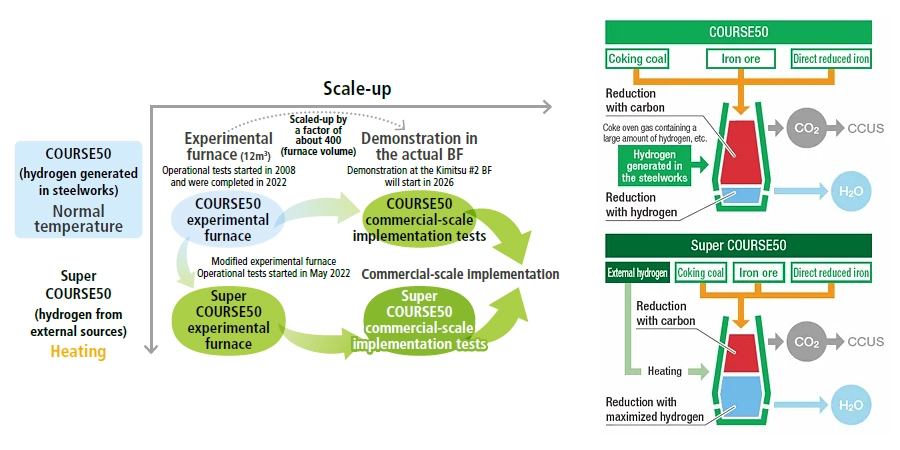
COURSE50 Project*1 Super COURSE50 Project*2
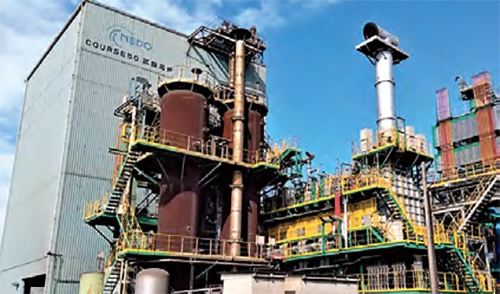
The COURSE50 is a technology development we undertook from 2008 to 2022 to realize steelmaking using hydrogen. At an experimental BF with a volume of 12m3 constructed in the East Japan Steel Works Kimitsu Area, we conducted operational tests on hydrogen injection into the BF using hydrogen-rich by-product gas (coke oven gas) generated within the steelworks, verified over a 10% reduction in CO2 emissions. We also developed an energy-saving CO2 separation and capture technology using a chemical absorption method, which led to its commercial-scale implementation in the industrial CO2 field.
The Super COURSE50 is a Green Innovation Fundsubsidized project that aims for a further reduction of CO2 emissions (50% or more). This is a technology for heating and using hydrogen purchased from external sources for maintaining the heat balance in the BF in anticipation of an era when social infrastructure for a sufficient hydrogen supply is available. Since the start of test in May 2022, we have steadily made progress, including the achievement of a 43% reduction in CO2 emissions from the BF during operational tests conducted in November to December 2024. This achievement sets a new world record.
- *1A project commissioned by the New Energy and Industrial Technology Development Organization (NEDO)
- *2An R&D project commissioned and subsidized by NEDO: Green Innovation Fund Project/ Hydrogen Utilization Project in Iron and Steelmaking Processes
Securing green hydrogen, green ammonia and green energy
To realize carbon neutral steelmaking processes, Nippon Steel alone would require several million tons of hydrogen and ammonia per year for use in hydrogen injection into BFs, hydrogen direct reduction of iron, and power decarbonization.
These hydrogen, ammonia and power must be green hydrogen, green ammonia and green power, which are produced without generating CO2.
In FY2024, the Hydrogen Society Promotion Act was enacted, which developed government support mechanisms, including "support focusing on the price gap" and the "hub development program" with a 15-year support period after the start of supply.
However, hydrogen and ammonia production costs are significantly higher than those of current fossil fuels, making a substantial cost reduction essential. Furthermore, large-scale hydrogen manufacture, transportation, and storage technologies require further development.
We are working to resolve the issue of affordable and stable hydrogen and ammonia procurement by collaborating with the national and local governments, as well as participating in various councils in the regions where our steelworks are located.
Efforts to reduce carbon emission in power generation
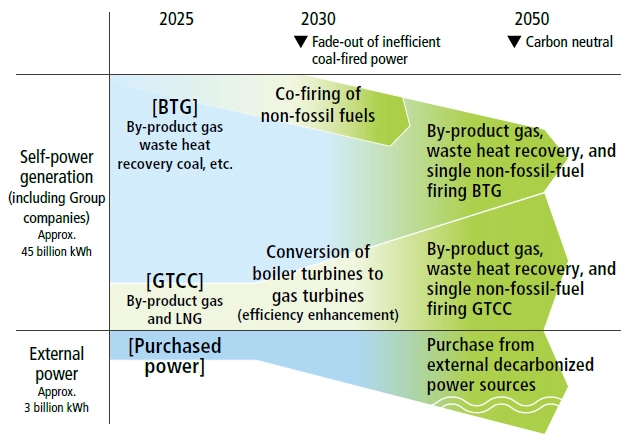
Nippon Steel generates 88% of the power consumed in its steelworks, 68% of which comes from internally generated energy sources, including waste heat and by-product gases. We also use LNG, petroleum, and coal as external-source auxiliary fuels.
Thus, we will promote the decarbonization of our power structure through fuel conversion to non-fossil fuels (hydrogen, ammonia, and biomass) and efficiency enhancements in our self-generation facilities, thereby accelerating CO2 emission reduction toward 2050 including the decarbonization of purchased electric power.
- Issues to consider and promote reducing carbon in the electric power structure
-
- Total elimination of inefficient coal-fired power
- Increase efficiency in thermal power fired by by-products, utilization of CCUS, and use of non-fossil fuels for external auxiliary fuels
(expanded use of zero-emission fuels such as biomass, ammonia, and hydrogen) - Purchase of decarbonized electric power from external sources
CCUS technology development
CCUS is a technology that separates and captures CO2, utilizes it directly or by converting it to other substances, or stores it underground. In carbon neutral steel production processes, CCUS technology is used to capture and store remaining CO2 emitted from the steel manufacturing process after minimizing CO2 generation.
The Nippon Steel Group is aggressively engaged in developing these technologies to help realize the social implementation of CCUS.
Click here for details on “Advanced CCS Support Project by JOGMEC”
Nippon Steel Group’s CCUS technology development efforts
Capture
CO2 Separation and Recovery Technology
(NEDO COURSE50 Project)
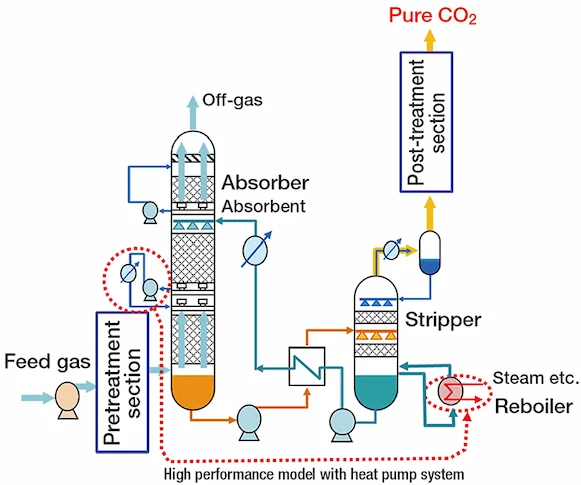
Nippon Steel Engineering Co. in the Nippon Steel Group has commercialized an energy-saving CO2 chemical absorption process called ESCAP™(Energy Saving CO2 Absorption Process), which uses chemical absorption, one of the methods for CO2 separation and recovery. Two units are already in operation in Japan, including the one installed in the North Nippon Works Muroran Area.
The ESCAP™ is characterized by high energy efficiency with a more than 40% reduction in heat consumption compared to general-purpose technology. In addition, its proprietary impurity removal facility enables recovery of more than 99.9% of high-purity CO2 from raw material gas with high impurities.
Development of low–concentration CO2 separation and capture technology
(subsidized by the Green Innovation Fund)
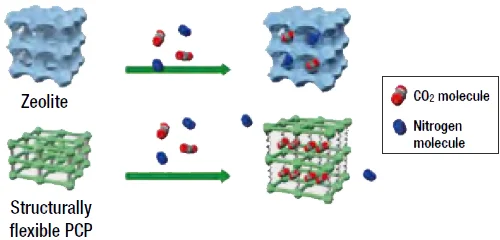
Nippon Steel, in collaboration with Oita University, Osaka University, Kyoto University, Chiba University, Nagoya University, Hokkaido University, and Resonac Corporation, started the full-scale development of separation/capture technology for low-concentration CO2 contained in industrial emission gases.
To separate/capture CO2 efficiently from low-pressure, low concentration emission gases (with a CO2 concentration of 10% or less at the atmospheric pressure), we are working on the development and social implementation of a new CO2 separating agent (structurally flexible PCP), which has higher CO2 selectivity and enables CO2 adsorption and desorption with minimal levels of pressure operation.
Transportation
Integrated CO2 ship transportation (NEDO–commissioned project)
Jointly with Japan CCS Co., Engineering Advancement Association of Japan, and ITOCHU Corporation, and Nippon Gas Line, we have commenced the R&D and demonstration project related to a CO2 transport vessel.
Storage
CO2 storage technologies
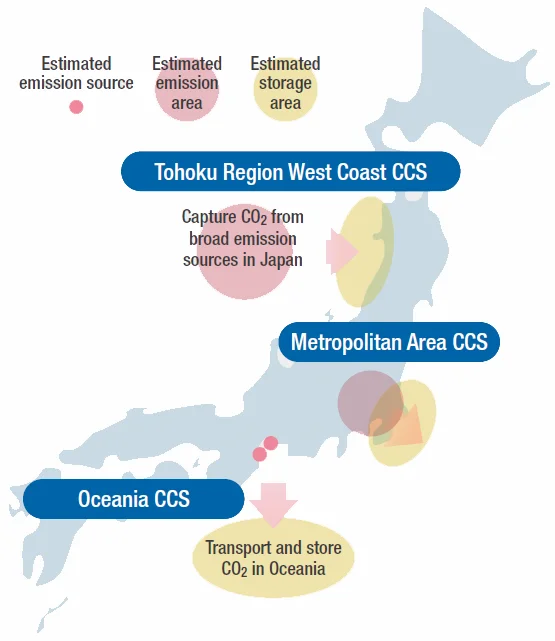
Nippon Steel participates in three CCS-related joint projects, the Tohoku Region West Coast CCS Project, the Metropolitan Area CCS Project, and the Oceania CCS Project, which the Japan Organization for Metals and Energy Security (JOGMEC) adopted in FY2024 as part of its publicly solicited project, the "Engineering Design Work for Advanced CCS Projects."
In these projects, we are conducting, jointly with other companies, the engineering design work for the entire CCS value chain and preparing the work for storage potential assessment as a follow-up phase to the post-feasibility study. At the same time, we are actively promoting the early social implementation of CCS by taking the lead in studies related to CO2 separation, capture, and liquefaction, as well as shipping terminals.
Utilization
Chemical product manufacturing technology using CO2 as a raw material
(project commissioned by NEDO)
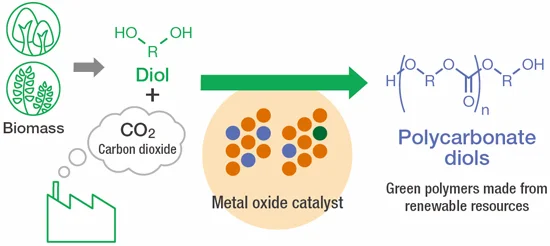
In April 2023, Nippon Steel, Osaka Metropolitan University, Kyoto University, Tohoku University, Tokyo University, and UBE Corporation started research and development on the “development of one-step synthesis process for polycarbonate diol from CO2.” Polycarbonate diol is a representative material for producing high value-added carbon compounds that do not require hydrogen. It is also a raw material for high-performance polyurethanes, widely used worldwide and whose demand is expected to grow further. However, the high environmental impact of its synthesis process has been a major issue. In contrast, this research and development aims to develop an innovative green process that effectively utilizes CO2 instead of highly toxic gases such as CO and achieves high yields in one-step synthesis.
Absorption and fixation by marine life
(subsidized as the NEDO Project)
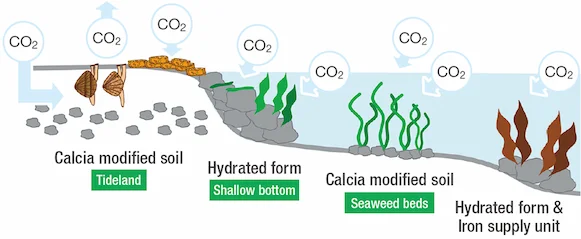
Develop and commercialize technology to create seaweed beds (blue carbon ecosystem) by using fertilizers made of steel slag, a by-product of steelmaking, in coastal areas.