
Responding to Climate Change-Governance,Management of Climate-related Risks,Target and Results-
The Nippon Steel Group recognizes that climate change is an important issue that affects the survival of humankind, and that it may have a serious impact on the business environment and business performance. In order to conduct business in a sustained manner, we are working to reduce the impact of climate change through initiatives to reduce CO2 emissions throughout the supply chain.
Governance concerning climate change
Nippon Steel recognizes climate change as one of its important managerial issues. As this issue may have a significant impact on our business environment and management, we have established the Green Transformation Promotion Committee, the level of which is equivalent to the Board of Directors. The Committee sets strategies, risk management policies, annual budgets, business plans, and performance targets related to climate-related issues, as well as deliberating and supervising the progress of them.
Among the matters discussed, decided, and reported by the Committees, significant matters are resolved and reported at the Board of Directors.
- Examples of climate-related issues reported or resolved at the Board of Directors
-
- Formulation of the Nippon Steel Carbon Neutral Vision 2050
- Expressing support for the purpose of the TCFD Final Report and disclosing information in accordance with the TCFD recommendations
- Green Transformation R&D and issues concerning actual implementation
- Procurement issues concerning green transformation
- Issues concerning green steel
- Response to the Green Innovation Fund
- Support for the GX League basic concept, participation in the GX League, etc.
Management of climate-related risks
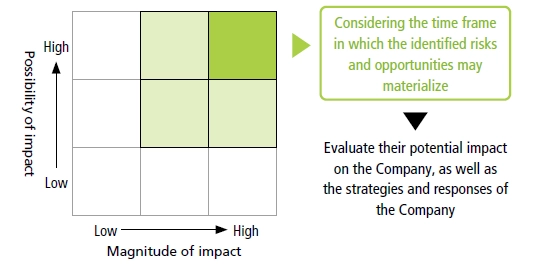
Recognizing external climate-related risks and opportunities, we identify risks and opportunities that could have a significant impact on our business in terms of impact on upstream procurement, direct operations, and downstream provision of products and services for each transition factor and physical factor. Specifically, from the perspectives of markets, policies, laws and regulations, technology, and reputation, we identify transition risks, physical risks, and opportunities that could affect upstream procurement, direct operations, and downstream provision of products and services. We then identify significant risks based on the likelihood of occurrence and magnitude of impact of those risks and opportunities.
The identified risks and opportunities are reported to the Board of Directors level committees as stated on the left, and significant risks are reported to the Board of Directors. These risks are thereby integrated into the Company’s overall risk management.
The Group’s CO2 emissions reduction target
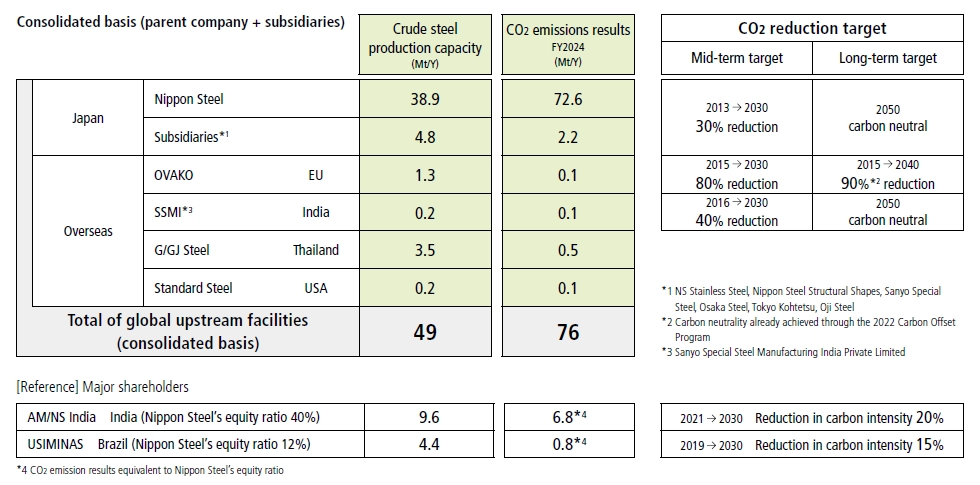
In addition to its independent “Nippon Steel Carbon Neutral Vision 2050,” we are tackling climate change measures as a member of the Nippon Steel Group at major domestic and international upstream facilities with high CO2 emissions, based on medium- to long-term CO2 emissions reduction targets.
As we expand our business in Japan and overseas in the future, we will continually and flexibly assess our climate change measures in accordance with the policy outlined below, while monitoring international trends, as well as developments in laws, regulations, and disclosure standards in other countries.
Meanwhile, U. S. Steel, which we merged with in June 2025, announced in 2019 a plan to reduce its Scope 1 and 2 GHG emission intensity by 20% compared to 2018 levels by 2030. The company also announced in 2021 another plan to achieve net-zero emissions by 2050.
Advance carbon neutrality at domestic and overseas upstream facilities by leveraging Nippon Steel’s resources and expertise gained thorough domestic R&D and operational activities
Domestic consolidation (parent company + subsidiaries)
- Targets are set for the group, including those of the parent company and consolidated subsidiaries
- Each company formulates its emission reduction plans to meet the group target
Overseas subsidiaries
- Their targets are set for each country and company, taking into account different conditions imposed by each country and region, and varying national reduction targets and transition strategies
Equity method affiliates (domestic and overseas)
- Each company’s target setting and carbon neutrality initiatives are supported in collaboration with the JV partner
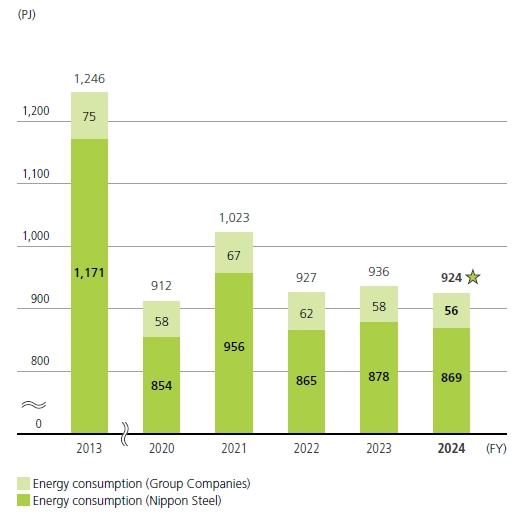
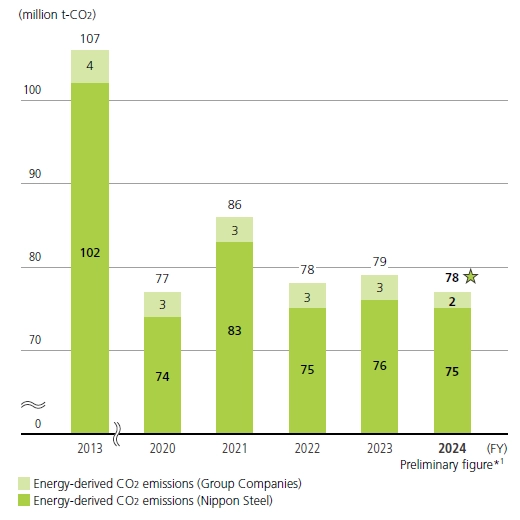
Nippon Steel Group’s energy consumption and energy-derived CO2 emissions
Nippon Steel has been working on energy conservation from diverse points: efficient using of energy generated in the steelmaking process (i.e., power generation from recovered by-product gas and waste heat); making operational improvements in each process; renovating older coke ovens and other equipment; introducing high-efficiency power generation facilities and oxygen plants; and employing reheating furnaces with the regenerative system.
In FY2024, despite a slight decline in production, we advanced energy-saving measures, resulting in a modest reduction in both energy consumption and energy-derived CO2 emissions.
Our energy-derived CO2 emissions accounted for 95% of our GHG emissions.
- Boundary of data collection
-
Nippon Steel*2, *3, EAF subsidiaries (Osaka Steel, Sanyo Special Steel, Nippon Steel Stainless Steel, Oji Steel, Tokai Special Steel, Nippon Steel Structural Shapes Corporation, Tokyo Kohtetsu, Ovako, Sanyo Special Steel Manufacturing India, and Standard Steel), and three Sanso Center companies*4
The data collection period used is each company’s accounting period. As Ovako has changed its fiscal year-end, Ovako’s fiscal 2021 results cover a period from January 1, 2021 to March 31, 2022 (15 months).
- Calculation method
Calculation for the Company and its domestic subsidiaries is based on the methodology of the Carbon Neutrality Action Plan.
Overseas subsidiaries follow local regulations or guidelines for calculation.
- Conversion factor
The Company and its domestic subsidiaries use the “Table of heat generation and carbon emission coefficient by energy source” (revised March 14, 2025) of the Agency for Natural Resources and Energy, METI.
Overseas subsidiaries use relevant emission factors according to local regulations or guidelines.
- *1Preliminary figure: The amount of CO2 per unit of purchased electricity from each of the general power companies in Japan in fiscal 2024 is assumed to be the same amount as in fiscal 2023.
- *2Excluding energy consumption and CO2 emissions associated with the IPP operation by the steelworks.
- *3The amounts of energy consumption required for and CO2 emissions from production of coke purchased by Nippon Steel are included in the aggregate.
- *4Concerning the three Sanso Center companies, the amounts of energy used and CO2 emitted for production of oxygen purchased by Nippon Steel Group are included in the aggregate.
Breakdown of Nippon Steel’s GHG emissions
| FY2020 | FY2021 | FY2022 | FY2023 | FY2024 | ||
|---|---|---|---|---|---|---|
| GHG Total | 77,153 | 86,873 | 78,125 | 79,764 | 79,013 | |
| Energy-derived CO2 | 73,950 [96] |
83,241 [96] |
74,829 [96] |
76,225 [96] |
75,349 [95] |
|
| Non-energy-derived CO2 | 2,977 | 3,383 | 3,079 | 3,280 | 3,389 | |
| CH4 | 97 | 108 | 99 | 104 | 114 | |
| N2O | 129 | 140 | 118 | 154 | 139 | |
CO2 emissions in the value chain
CO2 emissions originated from energy source and generated in Nippon Steel’s manufacturing process (Scope 1 and Scope 2) as well as CO2 emissions in the value chain (Scope 3), which are calculated by using the Green Value Chain Platform of the Ministry of the Environment and other methods are as follows.
Scope 1 and Scope 2 emissions
| CO2 emissions <Unit: K t-CO2, [t-CO2/t]> | Calculation method | |||||
|---|---|---|---|---|---|---|
| FY2020 | FY2021 | FY2022 | FY2023 | FY2024 | ||
| Scope 1 Direct emissions from owned sources associated with use of fuel |
63,170*3 | 71,311*3 | 63,403*3 | 64,020*3 | 63,672*1 | Based on the Carbon Neutrality Action Plan. |
| Scope 2 Indirect emissions from the generation of purchased energy |
11,035 | 12,458*3 | 11,912*3 | 12,425*3 | 11,423*1 | |
| Total | 74,205*3 [1.97] |
83,768*3 [1.88] |
75,315*3 [1.92] |
76,445*3 [1.93] |
75,095*1 [1.96] |
|
- Boundary of data collection
Nippon Steel*2 and EAF subsidiaries (Osaka Steel, Sanyo Special Steel, Nippon Steel Stainless Steel, Oji Steel, Tokai Special Steel, Tokyo Kohtetsu, Nippon Steel Structural Shapes Corporation, Ovako, Sanyo Special Steel Manufacturing India, and Standard Steel). The data collection period used is each company’s accounting period. As Ovako has changed its fiscal year-end, Ovako’s fiscal 2021 results cover a period from January 1, 2021 to March 31, 2022 (15 months).
- *1Preliminary figure: The amount of CO2 per unit of purchased electricity from each of the general power companies in Japan in fiscal 2024 is assumed to be the same amount as in fiscal 2023.
- *2Excluding CO2 emissions associated with the IPP operation by the steelworks.
- *3Due to a review of the summary values and changes in coefficients and other factors, the figure for this past year was revised retroactively.
- *4This does not include G/GJ steel.
- Conversion factor
The Company and its domestic subsidiaries use the “Table of heat generation and carbon emission coefficient by energy source” (revised March 14, 2025) of the Agency for Natural Resources and Energy, METI. Overseas subsidiaries use relevant emission factors according to local regulations or guidelines.
Scope 3
| CO2 emissions <Unit: K t-CO2> | Calculation method | |||||
|---|---|---|---|---|---|---|
| FY2020 | FY2021 | FY2022 | FY2023 | FY2024 | ||
| ①Purchased goods and services | 14,379 | 15,994 | 12,939 | 11,995 | 11,413 | Calculated for purchased iron ore, coking coal, coke, and oxygen*4. |
| ②Capital goods | 1,632 | 1,400 | 1,503 | 1,571 | 2,005 | [Amount of capital expenditures] X [Emission factor] |
| ③Fuel- and energy-related activities not included in Scope 1 or Scope 2 | 291 | 338 | 293 | 257 | 285 | [Amount of electric power procured and fuel used] X [Emission factor] |
| ④Upstream transportation and distribution | 629 | 710 | 638 | 611 | 585 | [Transportation distance reported in the Energy Saving Law document] X [Emission factor] |
| ⑤Waste generated in operations | 4 | 5 | 5 | 5 | 4 | [Amount of waste] X [Emission factor] |
| ⑥Business travel | 4 | 4 | 4 | 4 | 4 | [Number of employees] X [Emission factor] |
| ⑦Employee commuting | 14 | 14 | 13 | 13 | 13 | [Number of employees] X [Emission factor] |
| ⑮Investments | 1,125 | 1,053 | 1,193 | 1,124 | 1,334 | [Emissions by subsidiaries and affiliates that emit GHG of over 10,000 tons] X [Equity stake of each company] |
- Boundary of data collection
Nippon Steel
- *5Iron ore and coal: [Amount purchased of procured iron ore and coal] X [Emission factor]
Coke: [Amount purchased of procured coal at source] X [Emission factor] + [Amount of energy used in production of coke] X [Emission factor by energy source]
Oxygen: [Amount of energy used in production of oxygen] X [Emission factor by energy source]
- *5Iron ore and coal: [Amount purchased of procured iron ore and coal] X [Emission factor]
- Source of emission factor
"Emissions unit value database for accounting of greenhouse gas emissions throughout the supply chain (ver. 3.5)" (March 2025, Ministry of the Environment)
"Table of heat generation and carbon emission coefficient by energy source" (revised March 14, 2025) of METI, Agency for Natural Resources and Energy
CO2 emission reduction by manufacturing Blast furnace cement
By using blast furnace slag for cement production, we are able to reduce the amount of lime and fuel required, and reduce CO2 emissions per ton of cement by 320 kg (more than 40% reduction compared to ordinary cement).
CO2 emissions from cement production
| 2016 | 2017 | 2018 | 2019 | 2020 | 2021 | 2022 | 2023 | |
|---|---|---|---|---|---|---|---|---|
| Cement production (1,000 tons) | 208 | 216 | 218 | 207 | 199 | 186 | 191 | 178 |
| Cement production capacity (1,000 tons) | 335 | 355 | 335 | 335 | 335 | 335 | 335 | 335 |
| Clinker production (1,000 tons) | 130 | 136 | 131 | 130 | 125 | 120 | 115 | 113 |
| Clinker production capacity (1,000 tons) | 163 | 142 | 142 | 140 | 140 | 140 | 140 | 140 |
| Clinker / cement ratio | 0.63 | 0.63 | 0.60 | 0.63 | 0.63 | 0.64 | 0.60 | 0.58 |
| 2016 | 2017 | 2018 | 2019 | 2020 | 2021 | 2022 | 2023 | |
|---|---|---|---|---|---|---|---|---|
| CO2 emissions(1,000 t-CO2) | 118 | 122 | 117 | 117 | 110 | 105 | 107 | 103 |
| CO2 emission per ton of cement(kg-CO2/ton) | 567 | 564 | 536 | 563 | 555 | 561 | 561 | 579 |
Climate change measures in the resource recycling and biodiversity fields
—Blue carbon
Nippon Steel has promoted scientific analysis on usefulness and safety of use of steel slag — a by-product from the steelmaking process. To improve this technology, we began a basic study on blue carbon (CO2 absorption and fixation in the marine ecosystem), which is getting more attention as a measure against climate change.
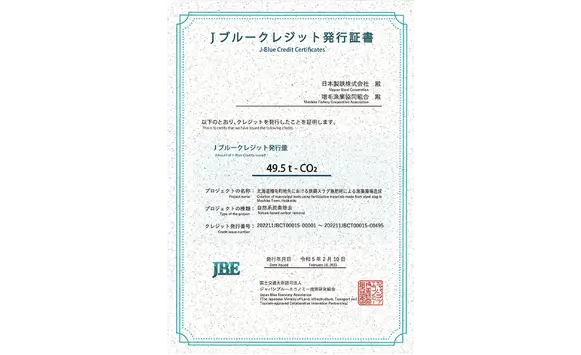
In fiscal 2022, we calculated the CO2 fixation effect in a seaweed bed development project, on which we have been working over the past nearly 20 years, applying for J-Blue Credit™ certification jointly with the Mashike Fishery Cooperative Association (Mashike, Hokkaido).
J-Blue Credit™ was certified and issued for 49.5 t-CO2 — the amount of CO2 absorbed and fixed (blue carbon) over the five years (2018 – 2022).
Further, in fiscal 2023, we submitted applications with joint applicants in Mashike-cho and Tomari-mura in Hokkaido, as well as in Kimitsu City, Chiba Prefecture, and J-Blue Credit™ for 33.3 t-CO2 were certified and issued as the amount of CO2 absorbed and fixed.
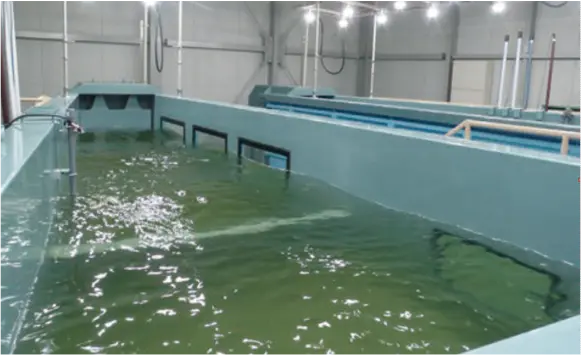
Also in fiscal 2024, we conducted demonstration tests of seaweed bed development in 32 sea areas nationwide, conducting continuous surveys of the changes in iron concentration in seawater before and after the test, as well as the growth status of seaweed. In addition to the acquisition of these basic data, we are working to advance seaweed bed development technology by providing theoretical support through scientific approaches, such as off-line testing using the “Sea Laboratory” (marine environment simulator) at the Research & Engineering Center of the R&D Laboratories (Futtsu City, Chiba Prefecture) and model analysis that reproduces actual sea conditions.
Adaptation to climate change
In addition to taking mitigation actions against climate change, we take into account the diverse impact of climate change and appropriately prepare for risks, as adaptive initiatives, and at the same time seek to capture business opportunities.
Preparation for risks
There is a risk that operations and shipments may be interrupted due to the flooding of steelworks and other events, including some caused by abnormal weather as a consequence of climate change. To prevent such risks, we are implementing measures against typhoons and heavy rains, measures to prevent crane overturn, installation of levees, reinforcement of embankments and gradients, and measures to prevent wind and flood damage at each steelworks.
Moreover, our steelworks have enhanced facilities to prevent water pollution. These facilities were provided to increase waste water treatment capacity and involved installation of a large storage tank so that water tainted with iron ore powder would not directly be released into the sea even if our steelworks were subjected to localized heavy rain.
In addition, some administration offices are built on a piloti structure, which means there is open space with no walls on the ground level. This makes the buildings less vulnerable to tsunami. This is a part of our efforts to be well prepared for emergencies such as flooding and high waves.
Capturing business opportunities
We have many products that are used for a long time as construction material for embankments and other public infrastructure. They contribute to providing solutions for “national resilience,” such as protecting towns from flooding or high tides caused by heavy rains or typhoons. Adaptation to climate changes also leads to business opportunities for Nippon Steel.
For example, we have developed and provided for actual use various types of products and product utilization technologies in the civil engineering field. They include hat-type sheet piles (contributing to national resilience in a wide range of ways, including measures against liquefaction of river levees, water leakage, and tsunami reaching coastal levee), linear-type steel piles (having a high-tensile strength at the joints, being suitable to cell-type quays, erosion-control dams and water shut-off work, and contributing to measures for sand embankments and against landslide at the time of heavy rain or a typhoon), and a method of preventing subsidence by use of sheet piles.