
Activities to Transfer and Diffuse Decarbonization Technologies Overseas ECO SOLUTION
Contribute to reduction of CO2 emission on a worldwide scale
With the understanding that the transfer of Japan’s advanced energy-saving technologies to overseas can be effective ways to globally reduce CO2 emissions, Nippon Steel is participating in many energy-saving and environmental initiatives in Japan and overseas. For example, we work with the World Steel Association and directly with countries such as China and India.
Japan’s steel industry can contribute to the reduction of CO2 emissions on a worldwide scale by transferring its advanced energy-saving technologies to emerging countries. The reduction effects of CO2 emissions by transfer of Japanese steelmakers’ energy-saving technologies to overseas have amounted to 77.67 million tons of reduction in CO2 emissions per year in total.
- *1All CDQ units were installed by the Nippon Steel Group (such as Nippon Steel Engineering).
- *2GTCC: Highly efficient GTCC power generation
- *3TRT: Top Pressure Recovery Turbine
| Number of units |
CO2 emission reduction | |
|---|---|---|
| CDQ*1 | 147 | 3,138 |
| GTCC*2 | 58 | 2,545 |
| TRT*3 | 66 | 1,195 |
| Oxygen Converter Gas collection | 22 | 821 |
| Sintering waste heat recovery | 7 | 98 |
| Oxygen Converter Gas waste heat collection | 8 | 90 |
| Total | 308 | 7,767 |
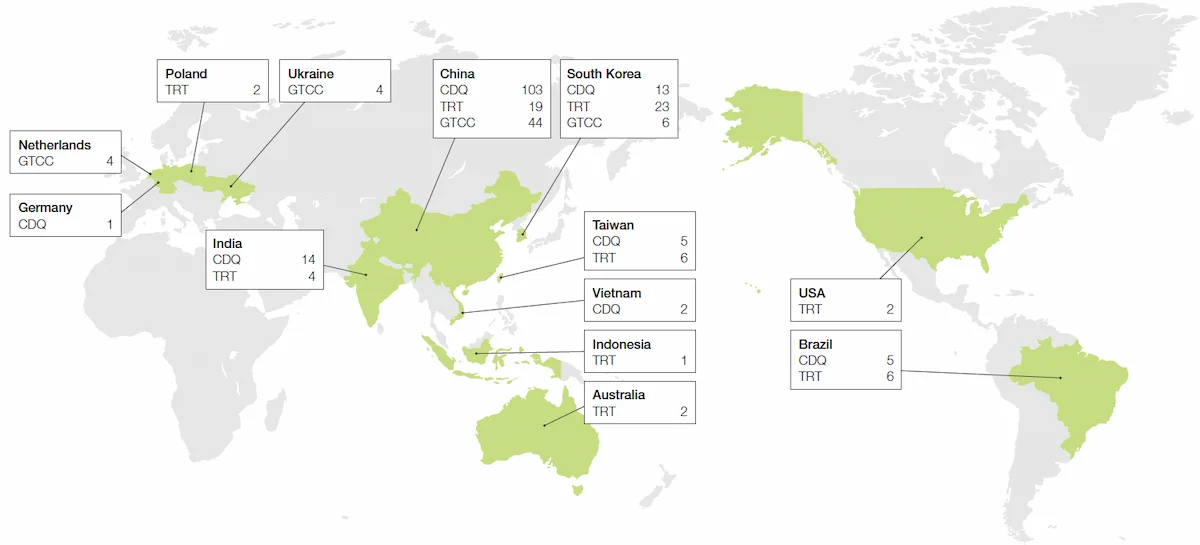
Japan’s steel industry’s nternational cooperation in energy conservation
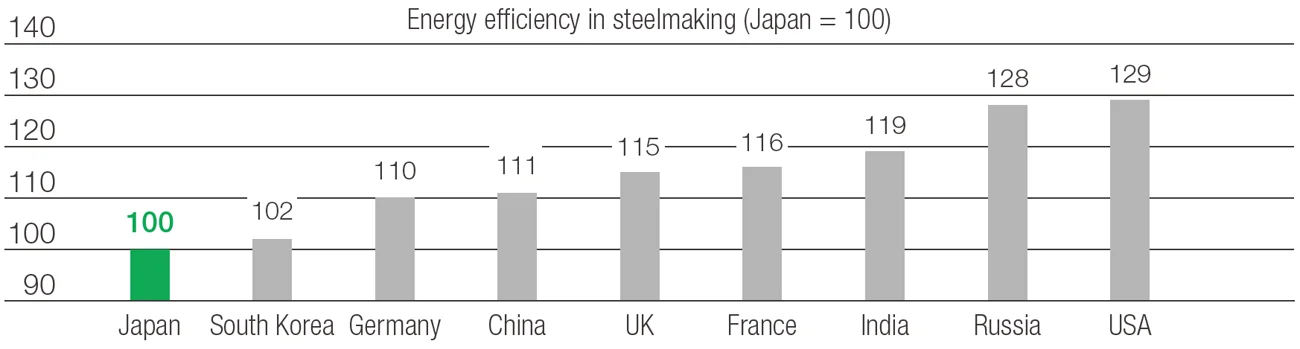
As a core member of the Japan Iron and Steel Federation (JISF), Nippon Steel is involved in multinational projects such as those for the Environment Committee of the World Steel Association.
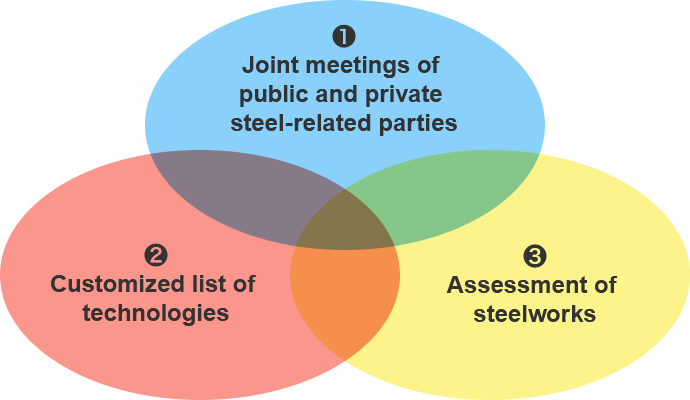
In addition, the JISF is promoting 1) joint meetings of public and private steel-related parties, 2) preparation of customized list of technologies, and 3) assessment of steelworks as to energy-saving status. These are the three pillars of collaboration for bilateral energy-saving and environmental cooperation with India, Southeast Asia, and other countries and regions.
1.Joint meetings of public and private steel-related parties
In public-private steel-related joint meetings, we share the technologies customized list, the results of assessment of steel mills, and introduce detailed technical information and financing schemes, in order to realize the early transfer of energy-saving technologies to emerging countries. By fiscal 2024, joint meetings have been held 13 times in India and 17 times in six ASEAN countries. In 2024, we held the “FY2024 Public and Private Collaborative Meeting between Indian and Japanese Iron and Steel Industry” with India and co-hosted an AJSI seminar with the Economic Research Institute for ASEAN and East Asia (ERIA). This seminar was held as part of the Southeast Asia Iron and Steel Institute (SEAISI) event, the “2024 ASEAN Iron and Steel Forum: Sustainable Steel and Green Construction,” where policies and private-sector initiatives toward carbon neutrality were shared.
2.The technologies customized list
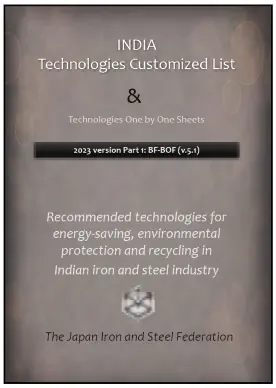
We identify the appropriate technologies for each country and region, and in addition to detailed technical information, we conduct the assessment of steel mills, and provide the technologies customized list, which complies with information such as on suppliers, for reference.
For the ASEAN countries, the technologies customized lists of 4.1 version for blast furnace (BF) steelmaking and 4.0 version for electric arc furnace (EAF) steelmaking have been released before now. In FY2023, for India, the 5.1 version for BF steelmaking and the 5.0 version for EAF steelmaking were released.
3.Assessment of steelworks
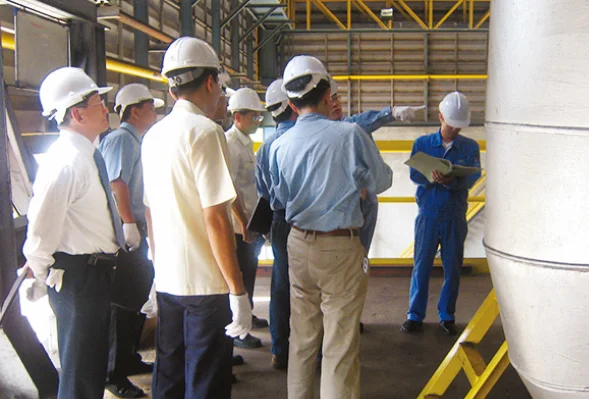
Experts from the Japanese steel industry visit the steel mills overseas to propose energy-saving technologies, provide operational improvement advice based on the operational conditions of the facilities, and conduct energysaving assessments of steel mills using the international standard ISO14404. Up to fiscal 2024, we had carried out the assessment of 14 steel mills in India and 18 mills in six ASEAN countries.
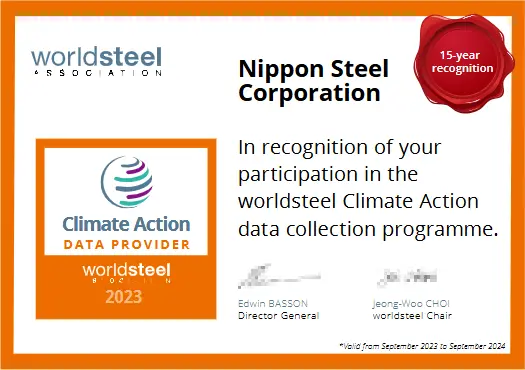
Nippon Steel participates in the Climate Action Program of the World Steel Association, which uses universal methods to calculate and report on the CO2 emitted by steelworks. As a Climate Action member (data provider), our 18 years of contribution have been highly recognized.