
Utlization and Development of Human Resources
Basic Policy
Recognizing that the source of our competitiveness is the power of our employees, we are working on human resource development as an important theme.
Basic Policy
Basic Policy for Human Resource Development
Our human resources development aims to cultivate individuals who understand and embody our Corporate Philosophy and Employee Action Guidelines. With this in mind, each employee is expected to take the initiative in developing their own capabilities while also actively supporting the development of their subordinates.The foundation of our human resources development is the ongoing dialogue between supervisors and subordinates in the workplace, through which values, decision-making principles, and practical job skills are passed on. To clearly communicate and share this approach across the Company, we have established the “Basic Policy for Human Resources Development.”
The Nippon Steel Group's basic approach to HR development is for supervisors to mentor their subordinates, through daily dialogue on the job, transferring understanding and knowledge of criteria for judgment and of operational skills. In order for this mindset to be shared by all employees, the following Basic Policy for Human Resource Development has been adopted.
- [Basic Policy for Human Resource Development]
-
- 1HR development is the job itself, and supervisors play an important role in HR development.
- 2Each individual strives for continual personal improvement for further growth.
- 3Supervisors share objectives and outcomes of HR development clearly with their subordinates.
- 4OJT training is a basis of HR development and is complemented by off-the-job training.
Target and KPI
- Promotion of measures to develop human resources
Initiatives and Achievements
Number of training/learning hours
| FY2022 | 28 [0.80] |
|---|---|
| FY2023 | 35 [0.99] |
| FY2024 | 33 [0.94] |
Development of management personnel
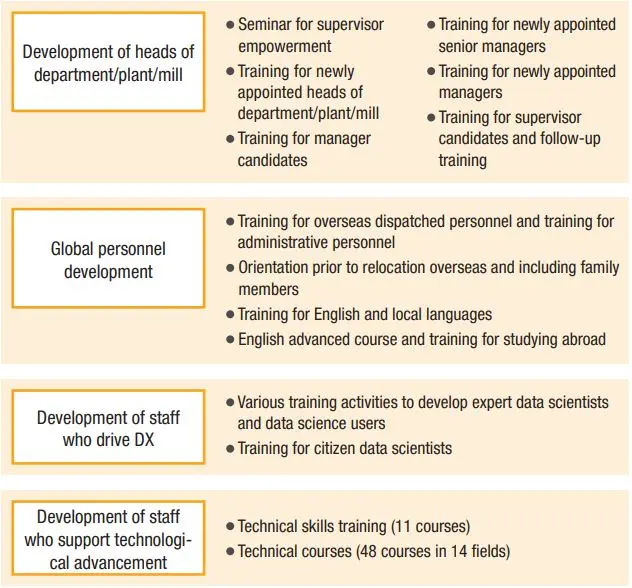
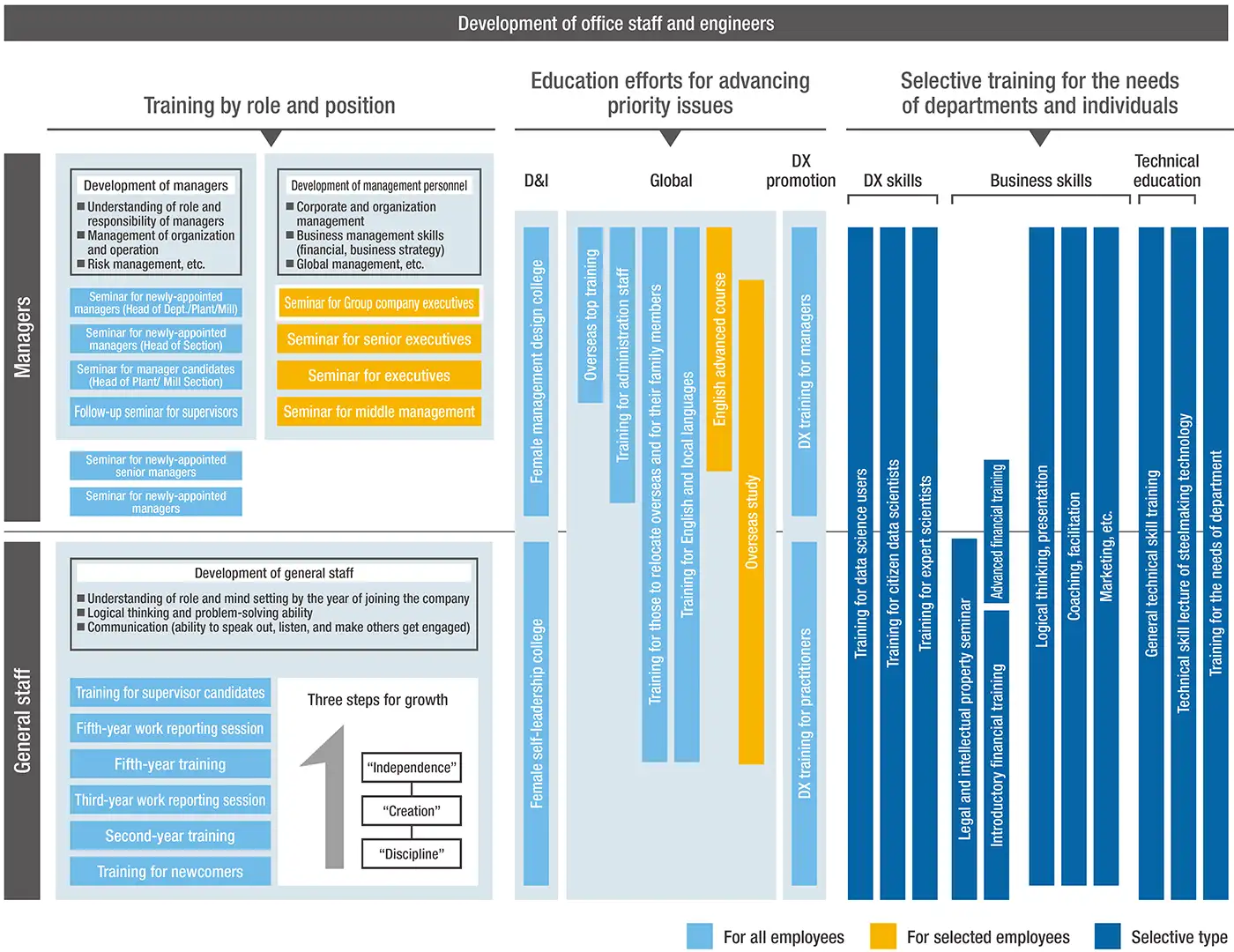
In order to develop management personnel who will be responsible for the future of the Group, we get to share policies and issues through dialogue with management and other means. In addition, we provide training according to the stage of their rank as candidates for management executives so that they can develop a broader perspective. Specifically, the program provides them with the opportunity to learn about corporate and organization management, business management skills (financial, business strategy), global management, etc.—contents which lead to strengthen the exchange and collaboration of personnel.

Development of human resources who support realizing management strategies
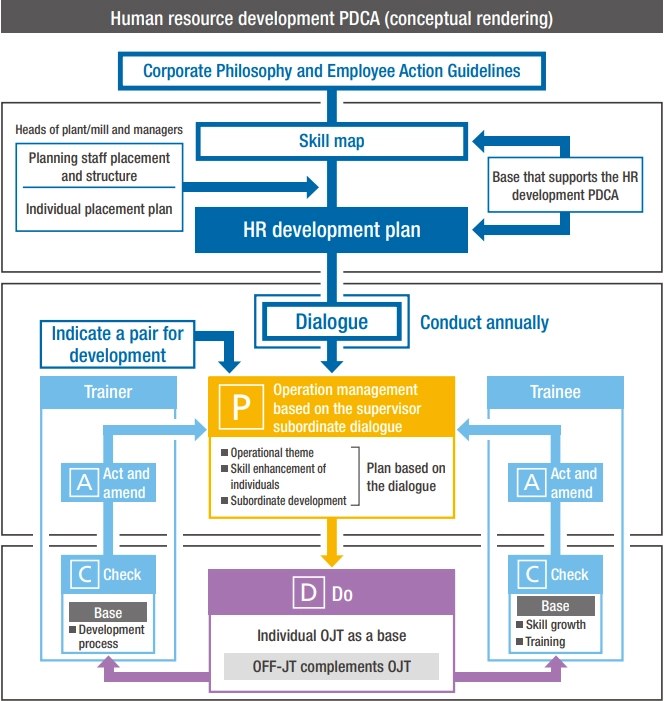
In accordance with the organizational strategy based on the Corporate Philosophy and Management Policy, the Nippon Steel Group uses an “HR Development PDCA” to effectively implement and establish the development of human resources.
A development plan is formulated for each person to conduct OJT, which is aligned with the supervisor-subordinate dialogue based on the “Assignment Commitment Sheet.” As of FY2025, we revised the Assignment Commitment Sheet and introduced one-on-one meetings between supervisors and subordinates to further enhance the effectiveness of dialogue. By improving both the quality and frequency of these interactions, we facilitate employees to develop and maximize their capabilities proactively and autonomously. Through these mechanisms, we are systematically fostering human resources capable of executing the strategies of each organization.
Each employee acquires the knowledge and skills required for each role and position and, in addition to rank-based training aimed at improving the abilities of employees as a whole, and selective training based on individual development needs, training measures that support the realization of management strategies are incorporated for promoting human resource development.
Career development
We are strengthening initiatives to enhance employees' engagement by promoting open feedback culture, as well as by creating opportunities for challenge and development such as overseas assignments for mid-career and junior employees, etc. As part of these efforts, we launched in-house entrepreneurship and in-house recruitment systems in FY2023.
Through the in-house recruitment system, we support employees' career development while revitalizing the organization by facilitating individuals with fresh perspectives and diverse skills to transfer. The in-house entrepreneurship system aims not only to develop human resources through entrepreneurial experience but also to foster a culture that encourages employees to take on new challenges beyond existing frameworks.
Personnel development of operators and maintenance staff
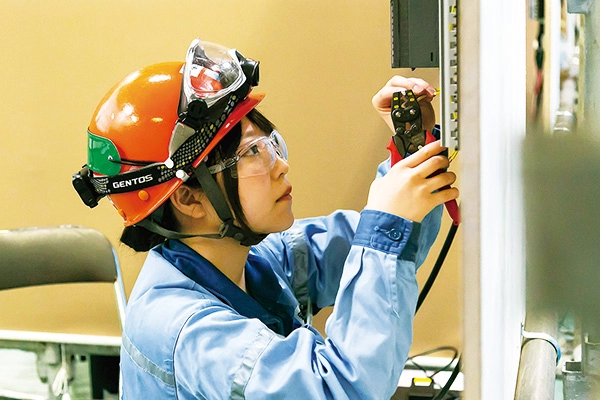
The operators and maintenance staff continuously build up their skills in steelmaking and maintenance, starting when joining the Company, on the assumption of continued long-term employment to retirement, thereby providing the fundamental support for the Company's on-site manufacturing capabilities. Promoting smooth transmission of technology and skills is essential and a system has been built, which cultivates all employees who joined the company to become fully skilled. Therefore, after making the skill or skills to be acquired clear by making a list as skills matrix, through a supervisor-subordinate dialogue, a detailed skill development plan is developed and carried out. Training is conducted mainly through On-the-Job Training (OJT) for individuals, and the HR Development PDCA is kept up to date for use by repeatedly revising and implementing the development plan based on the progress of OJT.
Off-the-job training (OFF-JT), which complements individual OJT, is used throughout the Company by organizing the minimum skills and knowledge required by each rank of employees of the Nippon Steel Group into a company-wide standard system.
Through this, we work at education of workplace leaders to further increase their ability to add to and improve our knowledge base from the field (“field technology”) and at measures to maintain and improve motivation of older people to continue working with health and motivation.
We are also actively promoting cooperation in HR development with partner companies, which play an important role in our steelmaking, from the perspective of deepening and expanding our partnerships. Specifically, in addition to the training of each partner company, we also conduct training for the employees of our cooperative companies. Level-specific training to impart and improve knowledge and skills needed for partner companies' employees in different ranks, such as newcomers, young staff, team leaders, job leaders, and line managers, is available, with Nippon Steel's employees serving as instructors.
Through these efforts, we support the HR development of our partner companies, encourage exchanges between our on-site employees and their employees, and establish a foundation for smooth business execution.
Another area we focus on is to diversify recruitment sources (especially for female employees and mid-career recruitment), and we strive to create a workplace climate in which diverse personnel can be motivated and collaborate with each other through human rights awareness and harassment prevention.
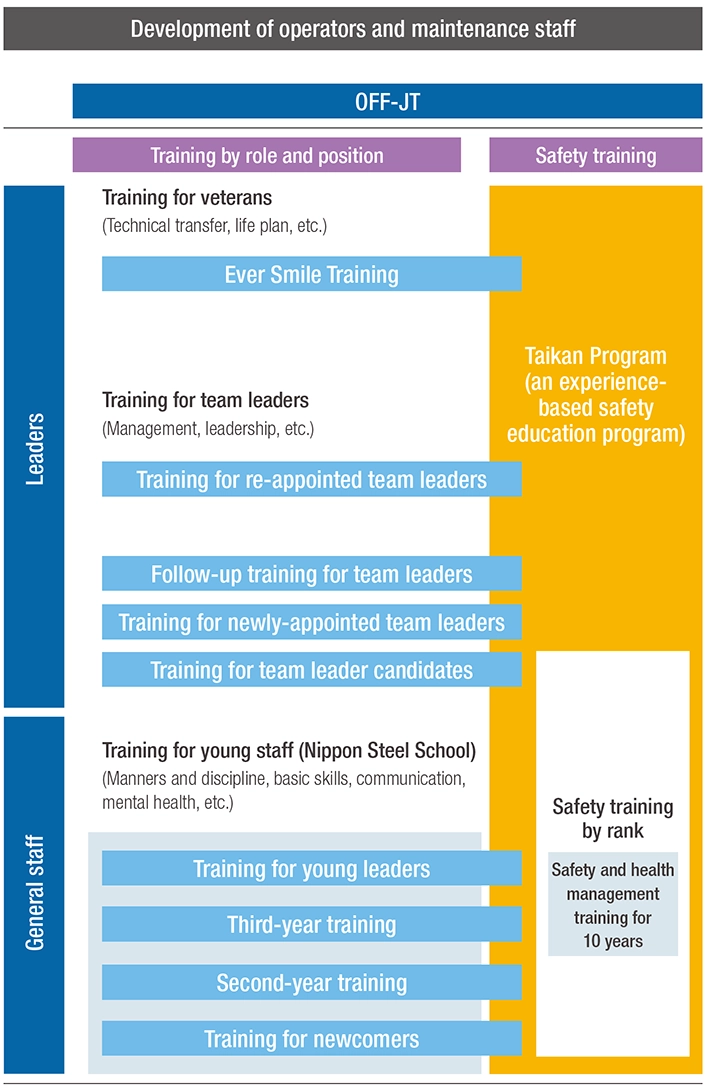
- *Note: In addition to the above, training to impart and improve knowledge and skills needed for partner companies' employees by rank (newcomers, young staff, team leaders, job leaders, and line managers) with Nippon Steel's employees as instructors is available.
Personnel treatment system
Nippon Steel's administering of personnel policies aim at encouraging our employees to grow and develop their overall capabilities, from the time they join the company until they retire. We also find it important to ensure consistent, fair evaluation of all employees regarding their capability and achievement by methods including through dialogue between supervisors and subordinates, and to appropriately reflect the evaluation to their conditions every year.