
Production and Supply Chain Management
To realize the production and supply of steel products required for a sustainable society, Nippon Steel is making various initiatives and DX (digital transformation) for stable procurement, stable production, and shipping in all aspects of the supply chain, from the procurement of raw materials, fuel, equipment, and materials to the shipment to customers.
Initiatives and Achievements
Sustainable procurement efforts
Under the development of the global economy, strategic procurement activities are needed to consistently secure and sustain competitive manufacturing capabilities.
At the same time, it is becoming increasingly important for not merely our Company but also our entire supply chain to fulfill social responsibilities to realize a sustainable society. Against this background, we procure raw materials, fuels, equipment, and materials essential for steel production, with the aim of contributing to development of both customers and economy, and the realization of a more prosperous society through the stable supply of competitive steel products.
In terms of procurement of raw materials and fuels, we are sourcing from suppliers worldwide, including Australia, North America, South America, and South Africa, for a stable supply of more than 100 million tons of raw materials for the steelworks. The supply of materials is mainly iron ore and coal. In the procurement of equipment and materials, we purchase around one million product items — from gigantic facilities such as blast furnaces to office supplies — from thousands of suppliers. Through active dialogue with our suppliers, we build trustful relations with them while pursuing stable procurement strategies that anticipate future changes in social structures. In addition, we conduct the “Partner Awards” and “Partner Questionnaire” annually to further strengthen collaboration with our suppliers.
In July 2020, we made a declaration for the establishment of partnership relations with suppliers and other business partners to establish cooperative and co-existing relationships.
In addition, based on the Nippon Steel Group Human Rights Policy adopted on April 1, 2024, we continue to conduct procurement activities with high ethical standards while giving maximum consideration to respect for human rights.
Basic policy on equipment and materials procurement
- 1Compliance with laws
- 2Equal opportunities
- 3Building of a partnership
- 4Fair disclosure of information and quick transaction processing
- 5Consideration to resource protection and environmental preservation
- 6Preservation of confidentiality
Consideration to Reducing Environmental Impact in Procurement Activities
Based on the Life Cycle Assessment concept, Nippon Steel is taking initiatives in reducing environmental impact at various points along the supply chain. In keeping with rising demand for tighter management of chemical substances, we have created management standards for 16 toxic chemical substances, including cadmium, jointly with customers and suppliers. We then established a system to manage substances of concern contained in purchasing materials and products, including packaging materials.
In addition, as stipulated in the Charter of Corporate Behavior by Keidanren, we have set up internal rules, including an appropriate purchasing policy, which puts us on record as fully considering resource protection and environmental preservation. Moreover, we have participated in the Green Purchasing Network (GPN) since 1996, when the network was founded, in order to promote green purchasing activities. Jointly with businesses, governments, academia, local governments, and NGOs, we have taken the initiative in developing a framework to prioritize the purchasing of products and services that represent less environmental load.
Laws, Directives, Standards for Toxic Chemical Substances Management We Comply
- Act on confirmation, etc. of Release Amounts of Specific Chemical Substances in the Environment and Promotion of Improvements to the Management Thereof (the PRTR Act)
- Industrial Safety and Health Act
- GHS Classification and Labeling of Chemicals
- JIS Z 7252, 7253
- Registration Evaluation Authorization and Restriction of Chemicals (REACH) Regulation
- Restriction of the use of certain Hazardous Substances in electrical and electronic equipment (RoHS) Directive
- Persistant Organic Pollutants (PoPs) Regulation
Efforts to stabilize production
We are focusing on stabilizing production, including the operation of blast furnaces and coke ovens, which have a particularly significant impact. Currently, the tapping ratio of the blast furnaces remains at a low level, and we are also focusing on developing operational plans under these circumstances.
In such efforts to stabilize production, we also frequently use solutions using DX. For example, in the case of identifying abnormalities in machinery and equipment and preventing problems, regular inspections by manpower had been performed in the past, but now with the installation of a large number of wireless vibration sensors, it is possible to monitor them 24 hours a day, and thereby quickly identify and respond to abnormalities. Further, by centrally managing the collected data and analyzing it with AI and machine learning, we can now obtain even higher value-added information.
Concerning blast furnaces, because it is difficult to grasp the situation inside the blast furnace, there have been cases where the intuition and experience of skilled operators have been relied on. Nowadays, it is by using technology that measures temperature, pressure, gas distribution, and other conditions in one second with sensors installed inside the blast furnace body and reproduces conditions inside the furnace with three-dimensional images that we strive to stabilize blast furnace operations and improve production efficiency. Through this type of simulation, we are developing automatic control that predicts future operating conditions and optimizes operations.
In order to deliver products that meet customer requirements on time, our head office unit in charge of overall management of sales and operations coordinates the relevant corporate-wide product manufacturing plans every day, while keeping track of sales and production. The process control units in each steelworks receive the plan and manage the progress of each single product while keeping in mind the productivity of each manufacturing base. These units work for optimal processing from manufacturing to shipment, and delivering products as scheduled.
Improve productivity in domestic logistics
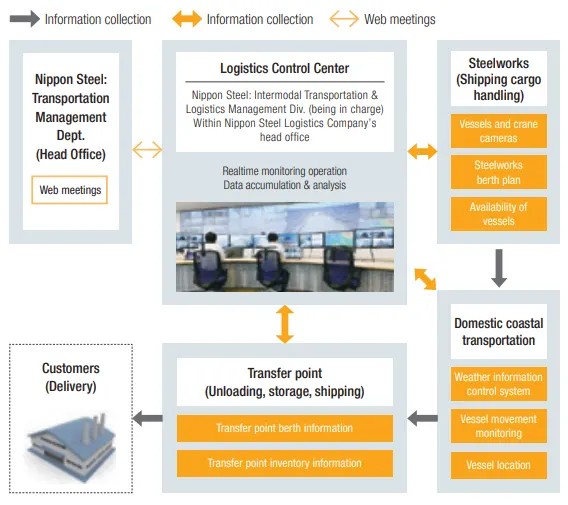
As challenges such as the “2024 logistics issue” and the growing workforce shortage in domestic logistics become increasingly evident, the Nippon Steel Group has established a new division within Nippon Steel Logistics to consistently manage and supervise operations.
This division is tasked with further improving efficiency by consolidating functions such as integrated logistics control and digital transformation (DX) planning. Specifically, at the Logistics Control Center, we leverage the latest systems of domestic logistics control to consolidate the information needed for allocation and control of the domestic vessels, such as their location data, progress rate of quay cargo handling at the steelworks, and the status of inventory at transfer points.
We then perform real-time monitoring and operation for the consolidated information. In addition, we are advancing company-wide management and supervision of truck transportation information, thereby improving efficiency across our integrated logistics network that includes domestic coastal vessels, transfer points, and transportation by truck—our primary transportation means.
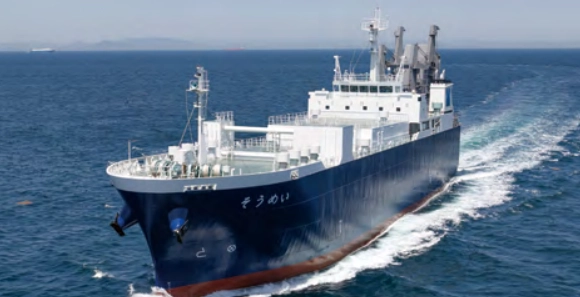
The Nippon Steel Group has commenced operations of Soumei, a roll-on/roll-off vessel* (RO-RO vessel) dedicated to steel products (hereinafter referred to as “the Vessel”), on the Kitakyushu–Sakai route.
The Vessel employs the roll-on/roll-off cargo-handling method, which saves labour force requirements at quaysides, while optimally integrating new technologies into existing port infrastructure. As a result, both loading capacity and cargo-handling efficiency have been improved by approximately 30%. In addition, various systems and equipment have been introduced to better accommodate seafarers’ working conditions, thereby contributing to alleviating the workforce shortage in domestic logistics.
Furthermore, the Vessel has been selected by the Agency for Natural Resources and Energy of the Ministry of Economy, Trade and Industry, together with the Maritime Bureau of the Ministry of Land, Infrastructure, Transport and Tourism, to participate in the “Project for Promoting Innovative Coastal Shipping Operations and the Shift to Non-Fossil Energy.” Specifically, it was adopted as a demonstration project for energy-saving small roll-on/roll-off vessels equipped with high-efficiency cargo-handling systems.
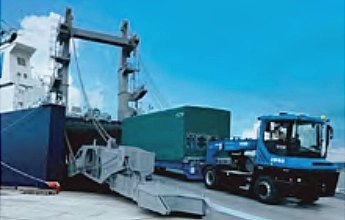
- *Roll-on/roll-off vessels allow trailers to drive on and off the ship to load and unload cargo, enabling crane-free operations at quaysides and reducing labor requirements for cargo handling.
• Adoption of roll trailers (load capacity: 60 tons) enables the transportation of heavy cargo.
• A two-tier cargo structure has been introduced, equipped with a large elevator (210 tons per lift).
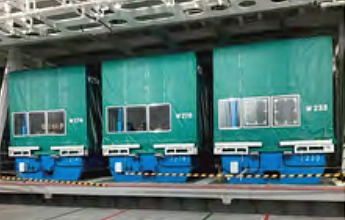
(accommodates three roll trailers at once)
Dealing with the workforce shortage in domestic logistics
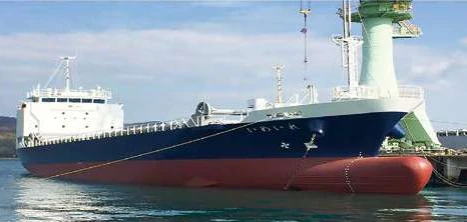
The Nippon Steel Group has therefore built a practical training ship, Reimei, and started its operation as one of the ways to secure crews. Many operators (shipowners) in the coastal shipping industry are small or medium-sized business persons and find it difficult to recruit and train new sailors even if they are willing because extra cabin space cannot be installed and the crew members find it burdensome to teach newcomers. Reimei is well designed with cabin space for an instructor and up to five trainee students, comfortable living space, a bridge, and a dining room, greatly contributing to the development of new sailors.
We will continue to make efforts for the sustainable development of domestic industrial logistics.