Safety
Basic Policy
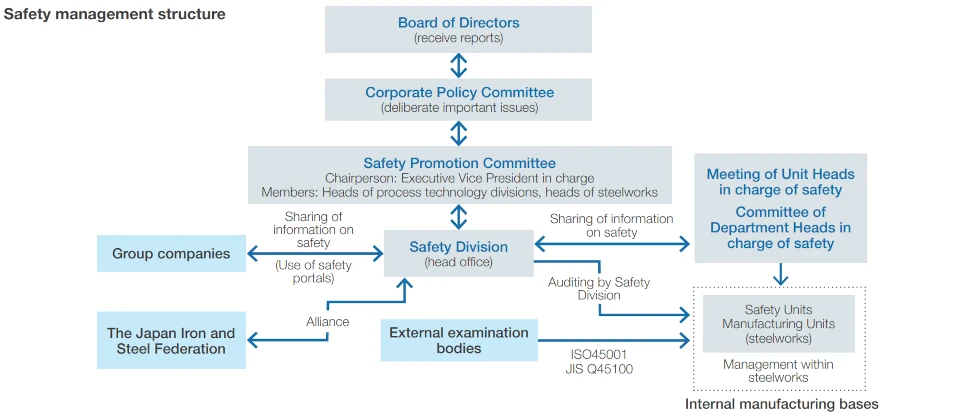
In keeping with the basic philosophy that “safety and health of employees of the Nippon Steel Group is the Group's most important, top-priority values and the basis that supports business development,” the Nippon Steel Group has firmly adhered to its manufacturing values, which include observing the principles of prioritizing safety, protecting the environment, and preventing disasters. We are working on all of the related activities to improve the level of our Occupational Safety and Health Management System (OSHMS) while creating safe and secure workplaces.
The Basic Policy on Safety and Health is applied to Nippon Steel as well as to related or cooperative companies.
Organization for health promotion
Target and KPI
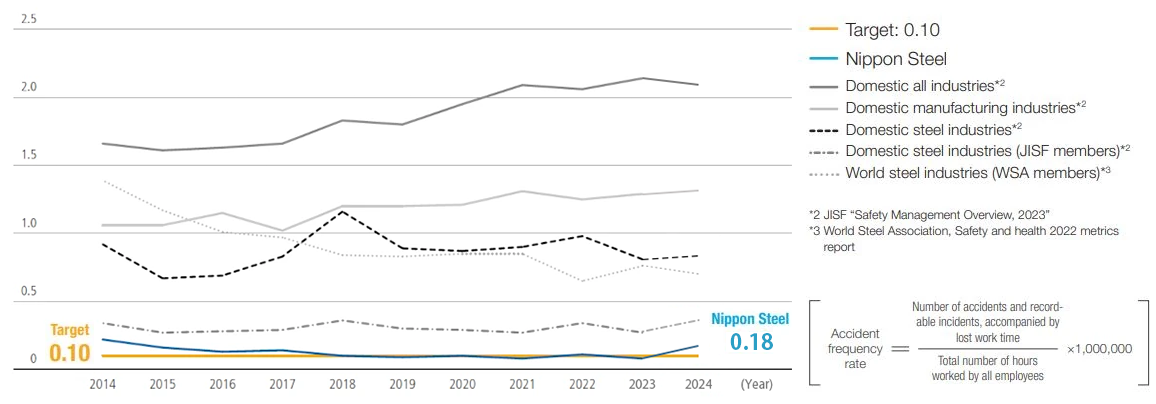
- Accident frequency rate 0.10 or less
- Zero fatalities accidents
Initiatives and Achievements
Reducing disaster risks to zero, and group-wide sharing of effective measures
We promote a risk assessment when planning a new project and regularly conduct safety and risk evaluation for existing projects,to prevent accidents and reduce risks. We also seek for the intrinsic safety of equipment and take countermeasures against human error. We also actively promote the use of IT in safety measures, such as introducing safety surveillance cameras or helmet-mounted cameras, or determining worker location data via GPS. Moreover, we conduct an analysis of actual accidents for the prevention of similar accidents and make effective examples of accident-preventive measures spread promptly. As a result of continuing these efforts, our safety performance in 2024 shows that the number of accidents accompanied by lost work time was 14 for the company*1 (including fatal cases of one), 18 for our cooperating companies (including fatal cases of one), and the comprehensive lost time injury frequency rate was 0.18 (vs. Japan’s steel industry average of 0.79). We will continue to strive for a safe work environment with the safety wellness targets for FY2025, which are zero fatalities/severe accidents and less than 0.10 as the comprehensive accident frequency rate.
| Accident frequency rate | 0.18 |
|---|---|
| Fatalities accidents | 2 |

- *1Nippon Steel's employees include seconded employees as well as temporary and part-time workers, and those dispatched to Nippon Steel.
Safety training
We are committed to enhancing training programs aimed at preventing accidents. These include safety and health training for newly appointed managers at manufacturing worksites (mandatory for all eligible personnel; 49 managers in FY2024) and hazard experience training, which enables workers to simulate workplace risks utilizing VR-based equipment. In addition, we conduct annual safety and health training for safety and health personnel from our Group companies and major cooperative companies (67 participants in FY2024). These programs are designed to improve knowledge about our safety and health initiatives, the procedures for implementing safety and health management methods such as internal audits, and the relevant occupational safety and health laws and regulations.
| Number of attendances in safety training programs | |
|---|---|
| FY2022 | 65 |
| FY2023 | 64 |
| FY2024 | 67 |
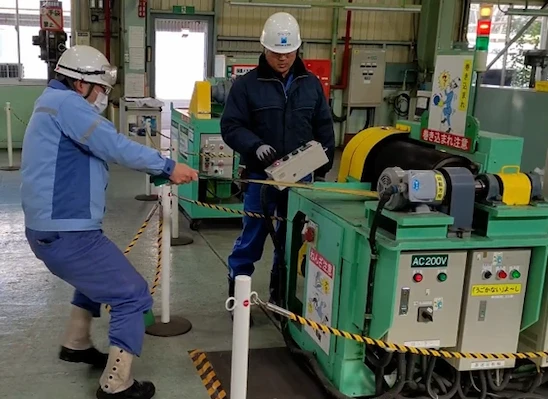
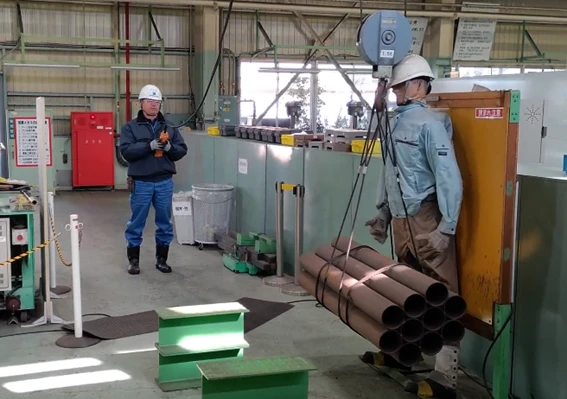
Risk Taikan (Experience-based) Education Program
Acquisition of third-party certification
Nippon Steel's all steelworks acquired ISO (JIS Q) 45001 Health and Safety certification (published in March 2018) as of March 2024.
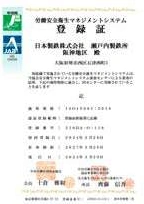
Health and Safety certification
| FY2019 | Kansai Works Wakayama Area |
|---|---|
| FY2020 | Amagasaki Area and Osaka Area of Kansai Works; Nagoya Works; Kyushu Works Oita Area; East Nippon Works Kashima Area |
| FY2021 | Naoetsu Area and Kimitsu Area of East Nippon Works, North Nippon Works Muroran Area, Setouchi Works Hirohata Area |
| FY2022 | North Nippon Works Kamaishi Area, Kyushu Works Yawata Area |
| FY2023 | Setouchi Works Hanshin Area |
Safety initiatives
Six Fundamental Safety Rules for Company-Wide Compliance
Nippon Steel has established the Six Fundamental Safety Rules for Company-Wide Compliance as our most important guidelines for ensuring safe operations. These Six Safety Rules are designed to address the most frequent causes of past accidents and to avoid risks that could lead to serious consequences in the event of an incident.
We have prepared a guidebook that presents work situations of non-compliance with these rules, along with actual accident cases, to enhance understanding of the Six Safety Rules among both our employees and those of our cooperative companies.
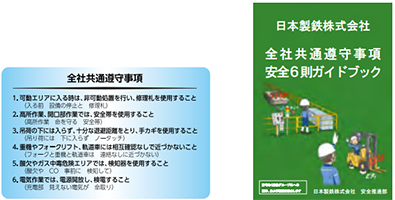
Ensuring safety through pre-work TBMs(toolbox meetings)
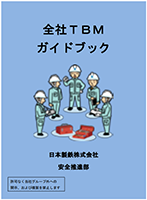
To ensure safe operations, it is essential to establish clear working procedures and assign roles to workers before commencing any task. While operation standards are defined for routine work, these standards are often not in place for infrequent or unexpected non-routine work. Before starting any non-routine work, a TBM is conducted in advance; however, implementation methods vary. To enhance work safety, we have developed the TBM Guidebook, which highlights key points for conducting TBMs and provides practical examples of both TBM and KY (Kiken Yochi – hazard prediction).