Research & Development
Nippon Steel is engaged in advancing strategic R&D, aimed at sustainable growth of the Nippon Steel Group
One of the world’s leading research resources
Our R&D resources are among the largest in the world in the steel industry, and we will contribute to the development of society through the R&D aimed at realizing our management plan.
| Pillars and contents of Medium- to Long-term Management Plan | Representative R&D |
|---|---|
Rebuilding of domestic steel business
|
|
Promoting a global strategy to deepen and expand overseas business
|
|
Challenge of carbon neutrality
|
|
Promoting of digital transformation strategies
|
|
Modern steelmaking in Japan began with iron ore as the raw material at the end of the Edo period and continues to progress today.
In recent years, in order to develop products that utilize atomic-level observation technology and advanced calculation science and technology, and to develop manufacturing processes for stably mass-producing them at low cost, various researchers with expertise in materials, physics, chemistry, mathematics, machinery, electricity, information, civil engineering and building construction are active and are participating in a wide range of academic societies both in Japan and overseas.
In the middle of the big game change in the decarbonization of society, steel is required to transform from the blast furnace method, which has extremely high production and energy efficiency. On the other hand, there is also a demand for developing products that contribute to the reduction of CO2 in society as inexpensive structural materials.
We will fully use our wide range of specialized technical capabilities and large-scale steel research resources fully for the R&D issues that are required in this era, and we will lead Japanese industry toward the realization of a carbon-neutral society.
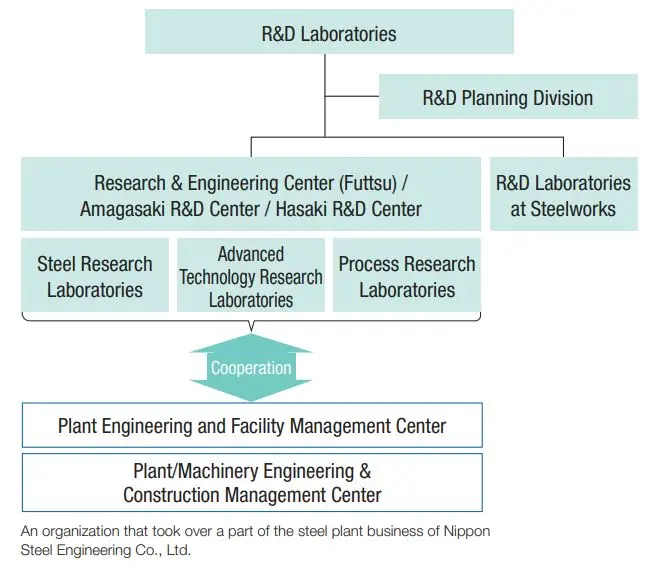
R&D organization
R&D is driven by the research and technology Laboratories and carried out through three research centers: the Steel Research Laboratories, the Advanced Technology Research Laboratories, and the Process Research Laboratories. Furthermore, we will strengthen cooperation with universities and research institutes in the fields that require basic understanding, including elemental technologies that our group does not possess.
(1) Steel Research Laboratories
Leveraging advanced capabilities in phenomenon analysis, microscopic materials design, and sophisticated numerical simulation, the Steel Research Laboratories develop new products by enhancing material performance and offering solution-oriented technologies that address user needs in key sectors such as automotive, energy, and infrastructure.
(2) Advanced Technology Research Laboratories
These laboratories are engaged in the development of advanced basic technologies, such as atomic-level materials analysis and mathematical modeling, while conducting R&D activities that span the entire Nippon Steel Group—from steel to advanced materials, and to the energy and environmental sectors. To realize a carbon-neutral society, the laboratories are also advancing technologies for the separation and capture of CO2 contained in blast furnace gas; the absorption and fixation of CO2 through the creation of seaweed beds using steelmaking slag; and the conversion of CO2 into value-added products through catalytic and microbial processes.
(3) Process Research Laboratories
These laboratories are engaged in the development of new technologies for ironmaking, steelmaking, and rolling processes; the advancement of environmental, energy, and resource recycling solutions; and R&D of process analysis, measurement and control and digitalization technologies that support these initiatives. We are also developing hydrogen-based steelmaking processes to contribute to the realization of a carbon-neutral society.
Developing products with high-added value and solution technologies
We will continue to work on maximizing the potential of steel as a material, that is, achieving our goal of “mastering steel.™ Furthermore, we are driving the development of “NSCarbolex™ Solution” which is a high-performance product with solution technologies and contributes to reducing CO2 emissions in society.
Next-generation automobiles
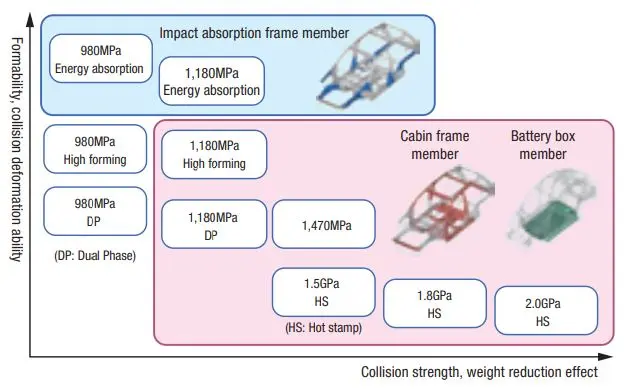
We are contributing to the reduction of environmental impact by developing and expanding the application of high-tensile steel sheets to achieve both weight reduction and collision safety of automobiles, developing high-efficiency electrical steel sheets for hybrid and electric vehicles, and improving fuel efficiency through the development of underbody products.
We are proposing the NSafe™-AutoConcept ECO3, a next-generation steel automobile concept for the era of carbon neutrality. This concept promotes part integration using steel to achieve key objectives: weight reduction, CO2 emissions reduction, cost efficiency, and labor-saving.
As one of the core technologies supporting this concept, we have developed tailored blanks of aluminized hot-stamped steel sheets. This innovation was honored with the 54th (FY2023) Japan Welding Engineering Society Award “Welding Notable Invention Award.”
Energy and resources/Shipbuilding
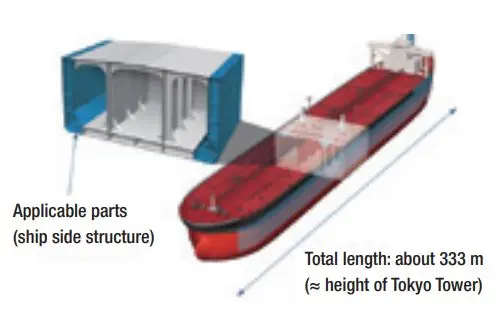
Steel materials for energy and shipbuilding require a quality that ensures long-term safety under various service conditions. We are contributing to improving the safety of final products and enhancing the productivity and competitiveness of customers by supplying high-performance products that utilizes advanced technology.
Civil engineering and infrastructure
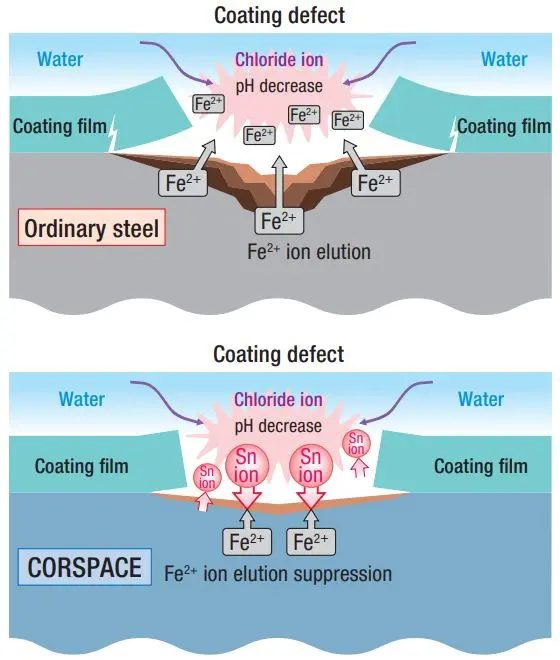
We accurately grasp market needs and continuously develop and supply building materials that exhibit our originality. We support social infrastructure such as construction (building pillars and beams) and civil engineering (roads/railways, rivers/harbor, building foundations). As an example of recent years, we have worked on basic research to explain the corrosion mechanism of coating defects in conventional steel materials and found that the addition of a small amount of element (Sn) to steel materials can suppress the elution of iron in a low-pH environment. We developed CORSPACETM, an extended coating cycle steel with excellent LCC, which can reduce the amount of steel corrosion and coating stripped surface in coating defects to about half that of conventional products. Thus, we have received the Excellence Award of the 9th “The Japan Monodzukuri Nippon Grand Awards” (2023) and the Contribution Award of the 55th “The Ichimura Prize in Industry” (2023). The steel materials and their elemental technologies are protected by a total of 78 comprehensively acquired patents.
Challenge of carbon neutrality
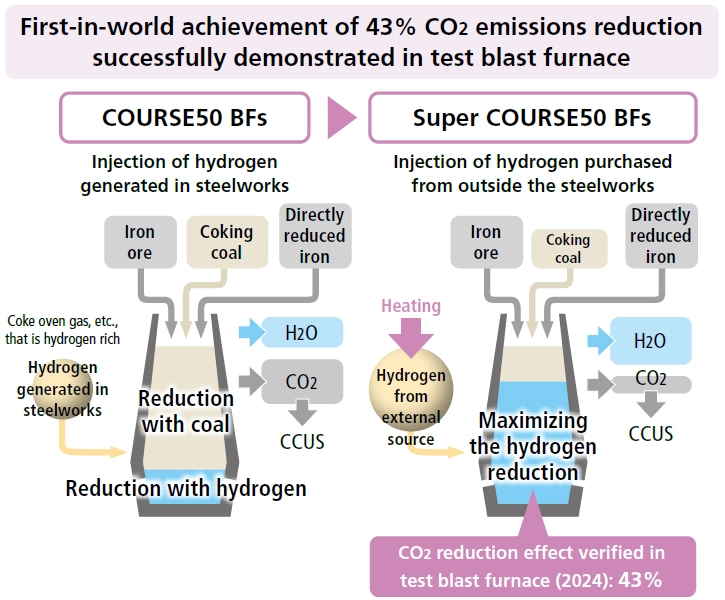
We aim to achieve carbon neutrality using three innovative technologies. “High-grade steel production in large size EAF” is based on the existing technology of the electric furnace, but there are issues in reducing impurities and increasing the size of the equipment. “Hydrogen direct reduction of iron” is a process producing reduced iron from iron ore using a shaft furnace, etc., without using a blast furnace, and there are still issues concerning stabilization of mass production. “Hydrogen injection into blast furnaces” is an effort to replace the reduction of iron oxide using carbon with hydrogen reduction, and the handling of hydrogen and the decrease in furnace temperature due to hydrogen reduction are issues.
Through the Green Innovation (GI) Fund Project of the New Energy and Industrial Technology Development Organization (NEDO), we are tackling these challenges by undertaking demonstration tests using a test blast furnace in East Nippon Works Kimitsu Area and a new test electric furnace and a test shaft furnace at the Hasaki R&D Center (Kamisu City, Ibaraki Prefecture). In 2024, we confirmed the world’s highest 43% CO2 emission reduction at the test furnace, making steady progress in development toward proposing the future steelmaking process.
In addition, we will conduct R&D of carbon offset measures using CCUS, etc., aiming for CN with a multi-aspect approach.